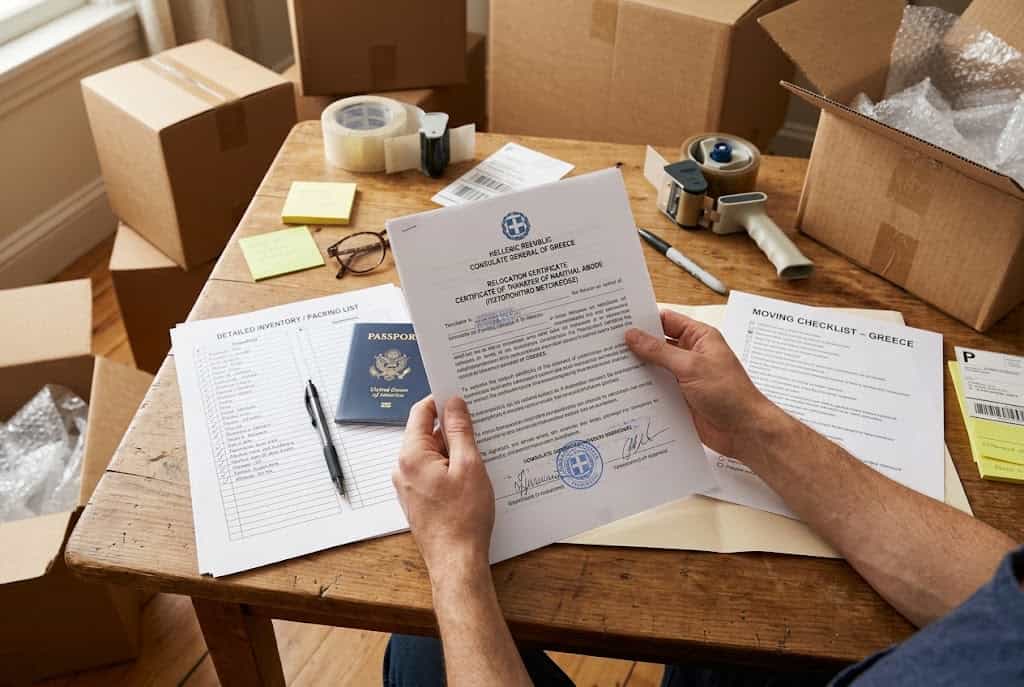

What Documents Do You Need to Move Household Goods from the USA to the UK?
Moving your household from the United States to the United Kingdom involves a specific set of documents that determines whether your goods clear customs duty-free or get held for review. The process is more structured than many destinations, but it is manageable when you understand what is required and why. Working with a licensed overseas moving company familiar with UK customs procedures makes a significant difference in how smoothly the clearance goes.
This guide covers the core document requirements for Americans shipping household goods to the UK, the Transfer of Residence (ToR) relief process, and what to expect at each stage.
The Core Document Set
UK customs requires the following for a standard household goods shipment from the USA:
Passport Copy
A clear copy of the faceplate page of your passport. This is required for the ToR application and for the customs entry made at the destination port. Make sure the copy is legible and current.
Detailed Packing List and Valued Inventory
Your inventory must list all items being shipped, described clearly in plain language and organized by room or carton. Each item should reflect its current second-hand value, not its replacement or insurance value. UK customs uses this document to assess what is being imported and whether any items fall outside the scope of ToR relief. Items that appear new, unopened, or recently purchased may attract additional scrutiny even if they are genuinely personal goods.
Higher-value items should include proof of purchase where available. For items without receipts, a written declaration noting the estimated current value is acceptable and should be included in the document package.
Copy of Bill of Lading or Airway Bill
This is the shipping document issued by the carrier confirming what is being transported and on which vessel or flight. Your destination agent in the UK will use this alongside your customs entry documents.
Proof of Residence Outside the UK
UK customs requires evidence that you have been living outside the UK and the EU for a continuous period of at least 12 months prior to your move. Utility bills, bank statements with a US address, or official correspondence showing your address over that period all work for this purpose. The stronger and more consistent the documentation, the less likely customs is to request clarification.
UK Destination Address
A tenancy agreement, property purchase confirmation, or a signed letter from a family member confirming you will be living at their address. If your long-term housing is not yet confirmed, a letter explaining your temporary living arrangements is acceptable, but a residential UK address must be provided for customs clearance purposes.
Supporting Documents Where Applicable
Depending on your circumstances, customs may also ask for an employment contract or employer transfer letter, a work permit or visa, a National Insurance number if you have one, and proof of ownership for any vehicles being included in the shipment. Not every client will need all of these, but having them ready speeds up the process.
The ToR01 Application: What It Is and Why It Matters
The Transfer of Residence (ToR) relief is the mechanism that allows Americans relocating to the UK to import their used household goods without paying import duties or VAT. Without it, your shipment may be assessed for duty at UK rates, which can be significant on a full container of household goods.
The application is made online through HMRC using the ToR01 form, available at gov.uk. SDC recommends submitting this application at least 10 days before your shipment departs. This is not a customs clearance request, it is an application to use the ToR relief heading, and the two steps are separate.
Eligibility Requirements
To qualify for ToR relief, you must be moving your normal home to the UK, have lived outside the UK and EU for at least 12 consecutive months, have owned and used the items being imported for at least 6 months prior to shipping, not have acquired them under any duty-free scheme, and commit to retaining them for personal use without selling or lending them for at least 12 months after importation.
The timing window matters as well. Your shipment can arrive no earlier than 6 months before your own arrival in the UK and no later than 12 months after. Shipments arriving outside this window may not qualify for relief.
The Unique Authorisation Code
Once HMRC is satisfied with your application, they issue a Unique Authorisation Code. This code must be provided to your destination agent before the shipment arrives at the UK port. The code authorises the use of the ToR relief heading for your customs entry. It is not confirmation that your goods have cleared customs, that step happens separately after arrival.
Items That Fall Outside ToR Relief
Certain items are excluded from ToR relief and require a separate written declaration submitted alongside the customs entry. These include alcohol and tobacco products, items that are less than six months old, and any restricted or prohibited goods. For alcohol, the declaration needs to include the number of bottles, type, size, alcohol percentage, and value. Tobacco declarations require weight and value. Duties assessed on these items will be communicated to you by your destination agent before clearance is finalised.
Items That Cannot Be Shipped to the UK
UK customs prohibits certain categories of goods regardless of ToR eligibility. These include unlicensed drugs, offensive weapons, counterfeit or pirated goods, any food items containing meat, fish, or dairy products, and any items derived from protected animal species, including ivory, reptile leather, and certain furs. Items derived from protected species can only be imported with a CITES permit.
Food items in particular are a practical concern. Including any food product in a household goods shipment, even inadvertently, can trigger a Port Health Examination, which adds delay and potential cost. Check all cartons before packing closes.
Storage and Timing Considerations
If your move timeline is uncertain, storage arrangements affect which documents you need and when. Goods stored in a UK warehouse after arrival and customs clearance can be held as long as needed without the 12-month ToR window becoming an issue, because clearance has already occurred. Goods stored in the USA before shipping preserve flexibility on departure timing but require coordination to ensure the shipment arrives within the ToR eligibility window relative to your own arrival date.
Your SDC coordinator will walk through the storage options and help you choose the approach that fits your timeline. Either way, a UK residential address is required for the customs process, even if you are initially delivering to storage.
Packing for a UK Shipment
Export-quality packing is strongly recommended for USA-to-UK shipments. The transit involves ocean freight, typically 3 to 5 weeks at sea, and the inventory presented to customs needs to match what is physically in the container. Cartons should be clearly labelled and correspond to the packing list submitted with your ToR application. Discrepancies between the physical shipment and the declared inventory are one of the most common reasons for customs delays on UK-bound moves.
Professional packing and crating services reduce both transit damage risk and the likelihood of customs complications. Cartons packed and sealed by an experienced crew are also easier to inspect and re-seal if customs requires a physical check.
If Your Move Is Specifically to the UK
For Americans planning a full relocation to the United Kingdom, Move From USA to UK covers the full picture of what to expect, including visa pathways, cost of living comparisons, and practical logistics for settling in. It is a useful companion resource if you are still in the planning stages of your move.
FAQs
Do I need to apply for ToR relief before my goods ship?
Yes. HMRC recommends submitting the ToR01 application at least 10 days before the shipment departs. Applying after the goods are already in transit is possible but creates unnecessary pressure and leaves no time to respond if HMRC requests additional information.
What happens if I do not qualify for ToR relief?
If you do not meet the eligibility criteria, your goods will be assessed for UK import duties and VAT. The rate depends on the type and value of the goods. Your destination agent will advise on what is owed before the shipment is released.
Can I include my car in the household goods shipment?
Left-hand drive vehicles from the USA generally cannot be permanently imported to the UK. The UK drives on the left, and permanently importing a left-hand drive car requires certified antique status or other specific exemptions. Confirm with your coordinator before including a vehicle in the shipment plan.
How long does customs clearance take in the UK?
When the ToR application is approved in advance and the document package is complete and consistent, clearance is typically straightforward once the shipment arrives at port. Delays occur when documents are missing, inconsistent with the physical shipment, or when a physical inspection is ordered. Planning your document submission well ahead of the departure date is the most effective way to keep clearance on schedule.
What is the 12-month rule for items?
Items being imported under ToR relief must have been owned and used for at least 6 months before the shipment date. Items purchased within 6 months of shipping are not covered by ToR relief and may be subject to duty even if the rest of the shipment qualifies. These items should be listed separately in your written declaration.