Moving from New York to Dubai
New York to Dubai is one of the most active long-haul relocation corridors for Americans, driven by finance, technology, and construction industry placements, as well as a growing number of entrepreneurs drawn to Dubai’s tax structure and business environment. This guide covers what the move involves in practical terms: how household goods are shipped from the New York metro area to Dubai, what UAE customs requires, how long the process takes, and what to expect at each stage. SDC International Shipping is an FMC-licensed door-to-door moving company with direct experience coordinating household relocations from New York to Dubai and the broader UAE.
Why Americans Move from New York to Dubai
Dubai attracts New York professionals for specific, practical reasons. The UAE imposes no personal income tax on earnings, which has an outsized effect on compensation packages compared to New York’s combined state and city tax burden. The business environment is structured for international commerce, with free zones that allow 100% foreign business ownership, and the city’s infrastructure and logistics position it as a regional hub for finance, trade, and professional services.
For families, Dubai offers well-established international schools, a large English-speaking expat community, and a standard of living that appeals to those accustomed to New York’s pace. The physical distance is substantial, roughly 7,000 miles, but Emirates and other carriers operate direct JFK to Dubai routes, which keeps the corridor manageable for people maintaining connections on both sides.
How Household Goods Are Shipped from New York to Dubai
The New York to Dubai corridor is served exclusively by ocean freight for full household moves. SDC ships from the New York and New Jersey port complex, with containers routing through the Suez Canal to the Port of Jebel Ali in Dubai, which is the primary container port for the UAE and one of the largest in the world.
Ocean freight transit time from New York to Jebel Ali typically runs 25 to 35 days depending on the specific routing and vessel schedule. Door-to-door delivery, which includes packing at the New York origin, export clearance, ocean transit, UAE customs clearance at Jebel Ali, and final delivery to the Dubai address, realistically takes 8 to 12 weeks from the date of origin pickup.
Container options depend on shipment volume. Most full household moves from New York use a dedicated 20-foot container, which suits a two to three-bedroom apartment. Larger households may require a 40-foot container. For smaller volumes, a shared container (LCL, or less than container load) consolidates your goods with other shipments heading to the same region, which reduces cost but requires more schedule flexibility.
Air freight is available for urgent smaller shipments, with transit times of two to three days to the UAE. Because air freight is charged by weight and volume, it is best reserved for selected essential items rather than full household contents.
UAE Customs Requirements for Household Goods
UAE customs clearance for household goods arriving at Jebel Ali is document-driven. The process is relatively straightforward when paperwork is complete and consistent, but gaps or errors in documentation are the most common cause of delays and additional costs.
Duty-Free Entry Conditions
Used household goods and personal effects qualify for duty-free importation into the UAE under two conditions: the items must have been owned and used prior to the move, and the shipment must arrive within six months of the owner obtaining a UAE residence permit. If the shipment arrives before the residence permit is issued, or more than six months after, duties may apply. New or unused items, including recently purchased goods brought as part of the shipment, are subject to import duty regardless of residency status.
Required Documentation
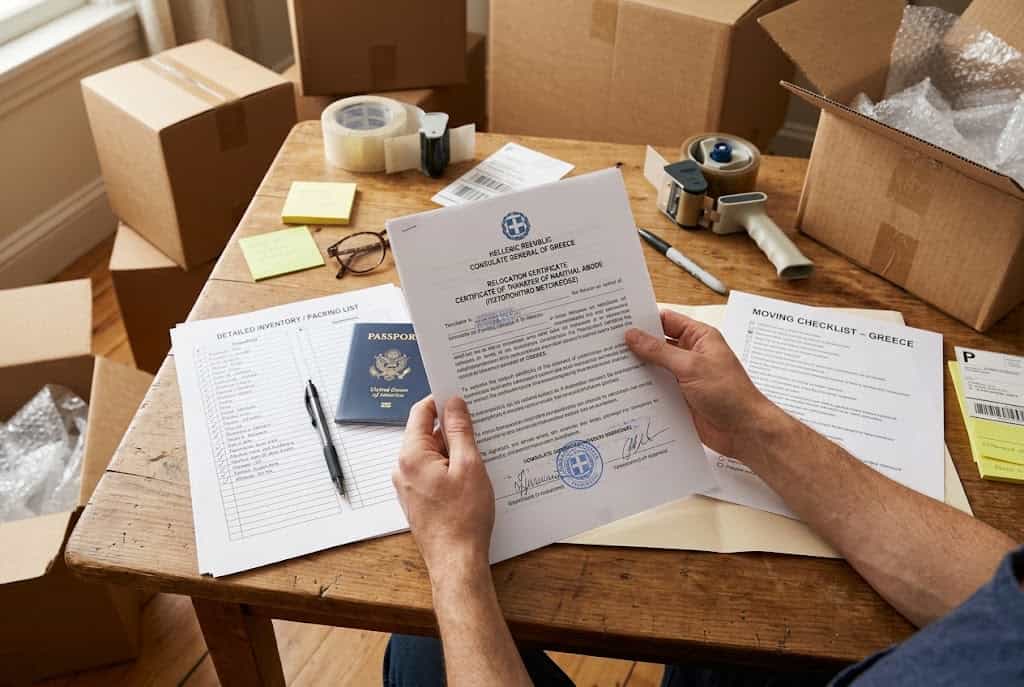
Standard documentation for a New York to Dubai household goods shipment includes:
- Valid passport copy
- UAE residence visa or Emirates ID (or proof of application in progress)
- A complete itemized packing inventory, signed and dated
- Bill of lading from the ocean carrier
- A non-commercial declaration confirming goods are personal effects and not for resale
Inventory quality is important. UAE customs officers may inspect shipments and verify contents against the inventory. Vague descriptions like “household items” or “personal effects” create questions; specific descriptions like “used kitchen utensils,” “hardcover books,” and “wooden dining table” move through inspection efficiently. SDC’s international packing and export documentation service builds the inventory at the time of packing, ensuring it is matched to labeled cartons and suitable for UAE customs review.
Restricted and Prohibited Items
The UAE enforces strict import restrictions that differ meaningfully from US standards. Items that are legal to own in New York may be prohibited from entry into Dubai. The most significant categories to be aware of before packing include:
- Alcohol: The UAE permits licensed import of alcohol in limited quantities for personal use by non-Muslim residents, but the rules are specific and subject to change. Do not pack alcohol in a household container without confirming current allowances with your SDC coordinator in advance.
- Pork products and related food items: Prohibited for general import.
- Medications: Certain prescription medications that are legal in the US are controlled or prohibited in the UAE. A UAE-valid prescription and prior approval may be required. Carry medications in your personal luggage with documentation rather than in a shipping container.
- Firearms and related items: Strictly prohibited in household shipments. These require entirely separate import processes and are not handled as part of a household move.
- Items featuring content that conflicts with UAE law: This includes certain printed materials, artwork, and media that may be acceptable in the US but are regulated under UAE content standards.
- Items made from protected species: Ivory, certain exotic leathers, coral, and related materials require CITES permits or are prohibited outright.
Screening your inventory against these categories before packing day prevents holds at Jebel Ali. Any item in a grey area should be flagged with your SDC coordinator before the container is loaded, not after it has shipped.
Packing and Preparing Your New York Household for Dubai
New York apartments present specific packing logistics. Elevator reservations, building move-out approvals, COI (certificate of insurance) requirements from building management, and narrow service entrance constraints all need to be coordinated in advance. SDC’s New York teams handle these regularly and build them into the move plan so that packing day runs without the building access issues that commonly cause delays.
The distance and transit time on the New York to Dubai corridor make packing quality more consequential than on shorter moves. Containers crossing the Atlantic and Indian Ocean are subject to temperature variation, humidity, and handling at multiple port facilities. Professional export packing using double-wall cartons, custom crating for fragile or high-value items, and proper sealing and labeling protects the shipment throughout a transit that can run five weeks or more.
High-value items including artwork, antiques, watches, and electronics should each have their own inventory line with a specific description and declared value. This supports both UAE customs clearance and insurance coverage, and ensures that these items receive appropriate packing attention at origin.
Settling Into Dubai After Your Shipment Arrives
Most American expats relocating from New York settle in Dubai Marina, Jumeirah, Downtown Dubai, or Business Bay, depending on proximity to work and lifestyle preference. Delivery coordination in Dubai requires advance notice to building management for access, particularly in newer tower developments where freight elevator and loading dock availability needs to be scheduled.
If your permanent Dubai residence is not ready when the shipment arrives, bonded storage at or near Jebel Ali is available while you finalize the delivery address. Planning for this contingency in advance, rather than improvising after the container clears customs, keeps the process predictable.
Frequently Asked Questions
How long does it take to ship household goods from New York to Dubai?
Ocean freight transit from New York to the Port of Jebel Ali in Dubai typically runs 25 to 35 days. Door-to-door delivery, including packing at origin, export clearance, ocean transit, UAE customs clearance, and final delivery, generally takes 8 to 12 weeks from the date SDC picks up at your New York address.
Do I pay import duties on my household goods when moving to Dubai?
Used personal effects and household goods qualify for duty-free importation into the UAE, provided the items were owned and used prior to the move and the shipment arrives within six months of the owner obtaining a UAE residence permit. New or unused goods, recently purchased items, and goods arriving outside the six-month residency window may be subject to import duties. Accurate documentation and a complete inventory are essential to supporting the duty-free classification at Jebel Ali.
Can I ship my car from New York to Dubai with my household goods?
Yes, vehicles can be shipped inside a container alongside household goods when the move is coordinated as a combined shipment. SDC does not offer standalone car shipping or RoRo for this corridor. Vehicles shipped to Dubai must be left-hand drive, as right-hand drive vehicles are generally not registrable for road use in the UAE. Import duty of approximately 5% on the CIF value plus 5% VAT applies to most vehicles. After clearance at Dubai Customs, a Vehicle Clearance Certificate is required before registration with the Roads and Transport Authority (RTA). Vehicles older than approximately 10 years typically require special RTA approval before road registration. Vehicle eligibility should be confirmed early in the planning process.