Moving from New York to the UK: Shipping Household Goods, TOR Relief, and What to Expect
The New York to UK corridor is one of the busiest transatlantic routes for household moves. British nationals returning home, Americans relocating for work, and dual citizens making a permanent change all make this move regularly. What they share is a need to understand two things clearly: how the physical shipping works from New York, and how UK customs relief works for used household goods. Get both right and the move is predictable. Get either wrong and it becomes expensive and stressful.
SDC International Shipping is a licensed, full-service overseas shipping company with a dedicated team in the New York metro area handling moves to the UK and throughout Europe. This post covers the shipping process, Transfer of Residency (TOR) relief, documents, timelines, and the practical details that matter most for an NYC-to-UK move.
How Shipping Works from New York to the UK
Household goods moving from the New York metro area to the UK travel by sea freight in a container. The Port of New York and New Jersey in Newark is the standard departure point for East Coast shipments heading to UK ports including Tilbury (near London), Felixstowe (the UK’s busiest container port), and Southampton.
Sailing time and total timeline
Port-to-port sailing time from Newark to Tilbury or Felixstowe runs approximately 10 to 14 days. That is the sailing time only. The full door-to-door timeline from packing day in New York to delivery at your UK address typically runs 4 to 8 weeks, accounting for origin packing and loading, port processing, ocean transit, UK customs clearance, and final delivery.
Moves where the TOR application is already approved before the shipment departs tend to clear UK customs faster than those where paperwork is still in progress on arrival. Starting the TOR process early is the single most reliable way to keep the timeline on track.
Container options from NYC
Most New York to UK household moves ship in either a 20-foot container (suitable for one to two bedrooms) or a 40-foot container (two to four bedrooms and larger). For smaller volumes, a shared container LCL (less-than-container load) groupage service is available, which consolidates your goods with other shipments heading to the same destination region. LCL costs less upfront but typically adds time to the overall transit due to deconsolidation at the UK port.
NYC apartments often contain more volume than their square footage suggests. A proper in-home or virtual survey before booking is worthwhile, since underestimating volume and having to upgrade the container size mid-booking creates avoidable delays and cost increases.
UK Transfer of Residency (TOR) Relief Explained
The most important UK customs topic for anyone shipping household goods from the US is Transfer of Residency relief, commonly called TOR or ToR. When approved, TOR relief allows qualifying movers to import their used personal belongings and household effects into the UK free of import duty and VAT. For a full containerload of household goods, this relief can be worth a significant amount of money.
Who qualifies for TOR relief
To qualify, you must meet all of the following conditions:
- You are moving your normal home to the UK.
- You have had your normal home outside the EU for a continuous period of at least 12 months.
- You have owned and used the goods for personal use for at least 6 months before importing them.
- You did not acquire the goods under a duty or tax-free scheme.
- You will not sell, lend, hire out, or otherwise dispose of the goods within 12 months of importation.
The shipment can arrive no more than six months before your own arrival date in the UK, and no more than twelve months after your arrival date. Timing matters, and a coordinator can help you align the shipping schedule to your move date.
How to apply: the TOR-01 process
The TOR application is made online through HMRC using the TOR-01 form. SDC recommends completing and submitting the application at least 10 days before your goods are shipped, and ideally earlier. The shipment should not depart until the outcome of the application is known, since it is far easier to manage the process before goods are in transit than after they have arrived at a UK port.
Once HMRC processes the application and is satisfied that the criteria are met, they issue a Unique Reference Number (URN). This URN is not customs clearance itself — it is the authorisation code that your UK destination agent uses to clear the shipment on arrival. The URN is provided to your UK moving partner and can cover both sea and air shipments under the same application.
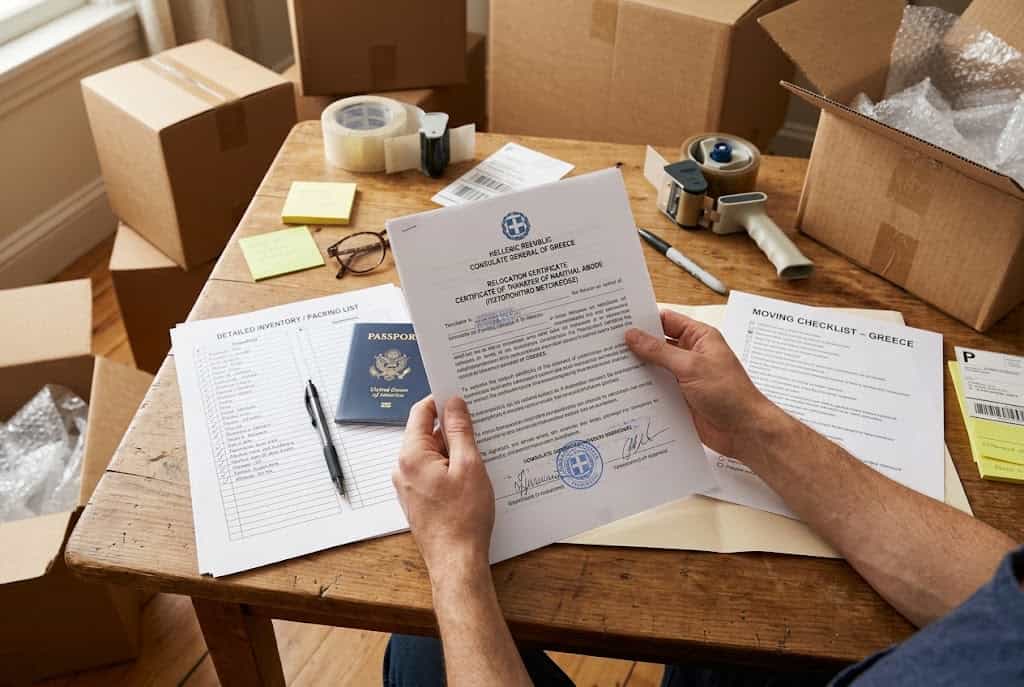
Documents required for the TOR-01 application
The following documents are submitted with the TOR-01 application to HMRC:
- Copy of passport (faceplate page)
- Visa, if applicable (for non-UK passport holders)
- National Insurance number, if available
- Packing list or survey list of goods being imported
- Proof of residency outside the EU for the last 12 months, such as a utility bill or bank statement with your address
- Proof of purchase or value for goods, especially higher-value items. Where receipts are not available, a written declaration estimating current second-hand value is acceptable
- Tenancy or purchase agreement for your UK address, or a statement that you will be living with family
- Employment contract or employer’s statement, if applicable
- Work permit, if applicable
- For vehicles: registration documents older than 6 months and proof of ownership
The completed form should be printed, signed, and emailed with all supporting documents to HMRC. HMRC may request additional information after receipt, so providing a valid and active email address in the application is important.
Items That Are Dutiable or Outside TOR Relief
TOR relief covers used household goods and personal effects, but not everything in your shipment automatically qualifies. Certain categories require separate handling.
Alcohol and tobacco
All alcohol and tobacco products are subject to duty and tax on importation into the UK, regardless of TOR status. They must be declared separately through the TOR-01 form with full details: for alcohol, the type, brand, strength (ABV), bottle size, quantity, and value of each bottle. For tobacco, the weight and value. For cigars specifically, the weight, number, and value.
Duty rates on alcohol and tobacco are high, typically 10 to 20% duty on the value plus 20% VAT on the combined total. In many cases it is more cost-effective to leave your stock behind and purchase in the UK rather than pay import costs on it.
Items less than six months old
Any item purchased within six months of importation is considered dutiable and falls outside TOR relief. New or recent purchases, particularly electronics still in retail packaging, attract attention during customs review. Items that look new should either be left out of the shipment or declared separately with their purchase value.
Prohibited items
The UK prohibits the following from being included in household goods shipments:
- Unlicensed drugs and controlled substances
- Offensive weapons and firearms (these require a licence)
- Foodstuffs, including any food product containing meat, fish, or dairy
- Animals, birds, and fish whether alive or preserved, and articles derived from protected species including ivory, fur skins, reptile leather, and coral
- Counterfeit or pirated goods
- Indecent or obscene material
Any item made wholly or in part from an endangered species product, including certain antiques with ivory components, requires a CITES permit for importation. If you own items that may fall into this category, flag them to your coordinator early so the documentation can be assessed before packing.
NYC Building Logistics for UK-Bound Moves
Moving out of a New York City apartment adds a layer of coordination that does not apply to most other origins. The following practical points apply specifically to the NYC end of a UK move.
Certificate of insurance requirements
Most co-ops, condominiums, and managed buildings in New York require the moving company to provide a certificate of insurance (COI) before any crew can enter the building. Some buildings require the COI to name the building or management company specifically. Confirm these requirements with your building management as soon as your move date is set, and provide the details to your coordinator so the COI can be prepared in advance.
Elevator reservations and move-time restrictions
Buildings with service elevators typically require advance reservations, and most restrict move times to specific weekday hours. Walk-up buildings require the crew to assess stairwell access for large items in advance. Narrow staircases and low ceilings in older Manhattan buildings are common, and experienced crews plan for disassembly of certain furniture pieces before removal.
Street access and parking
Parking a container truck or moving vehicle on a Manhattan or Brooklyn street requires coordination. In some locations a parking permit or temporary no-parking signage is needed, which adds a step to the logistics planning. This is handled by the coordinator as part of the move plan, but confirming your street situation early avoids last-minute complications on packing day.
Packing Standards for UK Shipments
UK-bound household goods are packed to export standard using double-wall cartons, professional wrapping for furniture and fragile items, and custom timber crating for high-value pieces such as artwork, mirrors, antiques, and pianos. The packing service covers the full preparation of goods at your NYC address, including a detailed descriptive inventory that meets HMRC’s requirements for the TOR application.
HMRC requires the inventory to be descriptive. Entries such as “miscellaneous items” or “packed by owner” are not acceptable for TOR clearance. Every carton and crate is logged with a description of contents, and the inventory is prepared in English and signed by the client before the shipment departs.
Storage Options for NYC to UK Moves
Some clients moving from New York to the UK are not ready to receive their goods immediately on arrival. Two storage options exist, and each has different implications for the TOR process.
Storing in the UK before delivery means the goods have already cleared customs when they arrive at the UK warehouse. This approach allows goods to remain in storage for as long as needed without the 12-month TOR window becoming a concern. A residential UK address must be provided for this option.
Storing in the US before shipping gives you more flexibility on the US side, but requires careful coordination of the shipping date to ensure goods arrive within the TOR window relative to your UK arrival date. Your coordinator can advise on which approach works best given your specific move timeline.
Frequently Asked Questions
Do I need to be in the UK before my goods arrive?
Not necessarily. Your goods can arrive up to six months before your own arrival date in the UK, provided the TOR application has been submitted and approved. However, goods cannot arrive more than twelve months after your arrival date and still qualify for TOR relief.
Can I include wine and spirits from my NYC apartment in the shipment?
Yes, but they are dutiable regardless of TOR status and must be declared in full on the TOR-01 form. Given UK duty rates on alcohol, most clients find it more practical to leave their wine and spirits collection behind rather than pay import costs on it.
How long in advance should I start the TOR application?
As early as possible, and at minimum 10 days before the shipment departs New York. HMRC may request additional information after receiving the application, and it is strongly preferable to have the URN in hand before goods are loaded. Starting the application at the point you first begin planning your move, rather than just before packing day, avoids unnecessary pressure.
Can I ship my car from New York to the UK in the same container?
Yes. Vehicles can be included in a container shipment alongside household goods. For TOR purposes, vehicle registration documents older than 6 months and proof of ownership are required as part of the TOR-01 application. Note that TOR relief does not apply to vehicles in the same way it applies to household effects — vehicle importation has its own separate requirements, and your coordinator will advise on the current rules specific to your vehicle and your situation.
What happens if my TOR application is still pending when my goods arrive?
If the URN has not been issued before the shipment arrives at a UK port, the goods may be held in a bonded warehouse until clearance is granted. This adds time and may add cost. It is one of the clearest reasons to start the TOR process early rather than leaving it until the move is imminent.
For more detail on SDC’s services from the New York area, including coverage across all five boroughs, Long Island, and Westchester, visit the New York international movers page.