Moving from Boston to France
Planning a household move from Boston to France takes real coordination across two countries, two customs systems, and a move corridor that rewards early planning. SDC International Shipping is an FMC-licensed door-to-door shipping company that handles household relocations from Boston to France from initial survey through final delivery. This guide covers what the move actually involves: logistics, customs, timelines, and the Boston-specific details that affect how your shipment gets started.
Boston to France: How the Move Works
A move from Boston to France follows a standard international household goods process, but the origin details matter. Many Boston residences, Beacon Hill, the South End, Back Bay, Cambridge, sit in historic neighborhoods with narrow streets, limited truck access, and buildings that require advance elevator reservations and certificates of insurance. If your building has a move window restriction or a street with no double-parking clearance, your packing schedule and container loading plan need to account for it from the beginning.
Boston also has two distinct seasonal peaks: May and August, when academic relocations from the university corridor create concentrated demand for packing crews and container space. If your move falls in either window, booking earlier gives you better options on both.
Most containerized shipments from the Boston area route through Conley Terminal at the Port of Boston for direct sailings to northern Europe, or through the Port of New York when a more frequent departure schedule or specific vessel is needed. Your coordinator confirms the routing based on your destination in France and your target delivery window.
Ocean Freight Options: FCL and LCL
For most household goods moves from Boston to France, ocean freight is the right method. The two options are a Full Container Load (FCL), where you have exclusive use of a 20-foot or 40-foot container, and a Less Than Container Load (LCL), where your shipment is consolidated with other cargo heading to the same destination port.
FCL works well for larger households, three bedrooms or more, or any move that includes a vehicle alongside household goods. LCL is typically more cost-effective for smaller volumes, a one or two-bedroom apartment, and remains a practical option if your timeline is flexible enough to accommodate consolidation and deconsolidation at the French port.
Ocean transit from Boston to France runs approximately 10 to 16 days for direct sailings. Door-to-door timelines, including packing, customs clearance, and final delivery, typically range from 8 to 14 weeks for FCL and 10 to 18 weeks for LCL. These are planning ranges, not guarantees. Your coordinator will provide a lane-specific estimate once your inventory and timeline are confirmed.
French Customs: What You Need to Qualify for Duty-Free Entry
France offers duty and VAT relief on household goods imported as part of a genuine change of residence, but the conditions are specific and the documentation is substantial. To qualify, your goods must have been owned and used for at least six months prior to shipment, and the shipment must arrive within 12 months of your French residency transfer date. A delivery address in France must be known and confirmed at the time of customs clearance.
The core document is the Attestation de Non-Cession, a signed original in which you confirm you have lived abroad for at least one year, that all items have been owned for more than six months, and that the goods will not be sold for 12 months after importation. This document is unique to France and catches some clients off guard when they first encounter it.
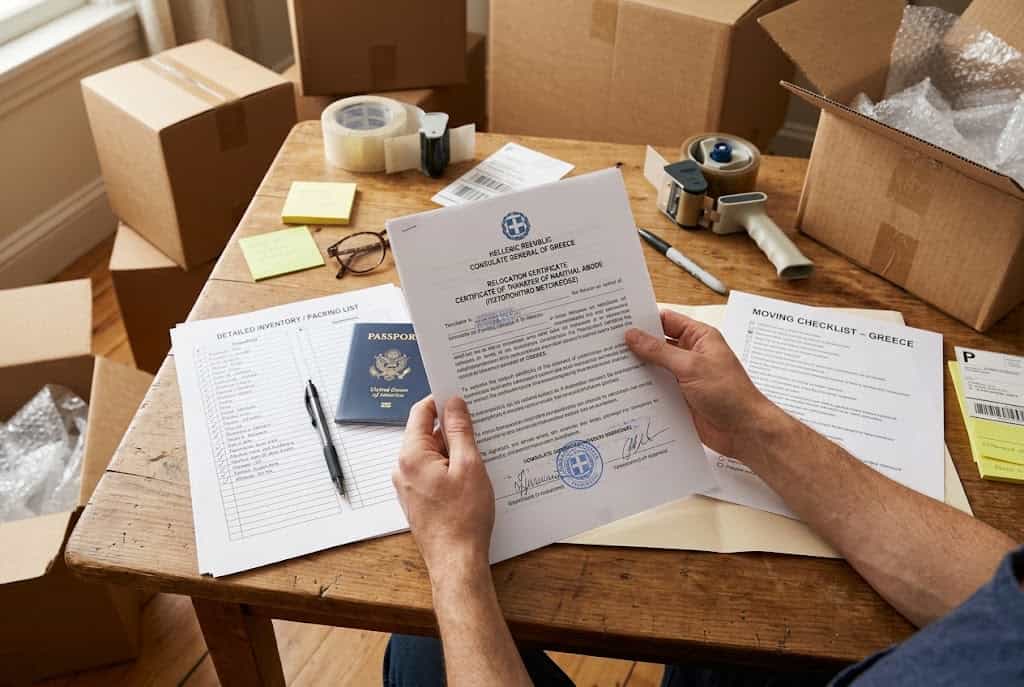
Other required documents include your passport copy, a Certificate of Change of Residence issued by the French consulate at origin confirming at least 12 months of residence outside the EU, a valued inventory in French valued in euros and signed by you, a detailed packing list with brand names and serial numbers for electronics, proof of address in France, and, if your move is employer-sponsored, a letter of professional transfer indicating your employment date abroad.
SDC provides templates for the valued inventory and the transfer letter during onboarding. French customs will reject clearance if the valued inventory is incomplete, unsigned, or submitted in English only.
Packing for a France Move
Export packing for a France move is different from domestic moving. The packing process creates a detailed inventory tied directly to your customs documentation, with each carton logged, labeled, and inventoried in a format French customs expects. Professional export packing also affects insurance coverage: most policies require professional packing for full replacement value protection on ocean freight.
French homes are typically smaller than American ones. The packing and inventory process is also a useful moment to decide what comes with you and what gets sold, donated, or stored. US appliances running on 120V/60Hz will not work on France’s 230V/50Hz grid without converters, and most are not worth converting. Your coordinator can walk through what to ship versus what to replace locally.
Delivery in France
Delivery in France carries its own access considerations. Paris and many historic city centers have narrow pedestrian streets, restricted zones, and buildings with limited elevator dimensions or low-clearance stairwells that require shuttle vans, hoisting equipment, or walk-carry plans. Your destination coordinator handles access planning for the French end, but giving your SDC coordinator early notice of your delivery address allows this to be built into the shipment plan rather than resolved at the last minute.
SDC delivers across mainland France, including Paris and the Ile-de-France suburbs, Lyon, Marseille, Nice, Bordeaux, Toulouse, Nantes, Strasbourg, Montpellier, Lille, and Grenoble, as well as Corsica with ferry transfer coordination.
FAQs: Moving from Boston to France
How early should I book my move from Boston?
Six to eight weeks before your target packing date is a reasonable minimum for most moves. During Boston’s May and August peaks, booking 10 to 12 weeks out gives you more flexibility on crew scheduling and container departures.
Do you handle moves from Cambridge, Brookline, and the suburbs?
Yes. SDC coordinates international household moves throughout Greater Boston, including Cambridge, Brookline, Newton, Somerville, Quincy, and surrounding communities. Origin access challenges in these areas are standard and planned for during the survey.
Can I ship a piano or artwork from Boston to France?
Yes. Pianos and fine art require custom crating, specialized loading procedures, and careful container placement. Let your coordinator know early so the right materials and crew expertise are scheduled for packing day.
What happens if my French address is not ready when my shipment arrives?
This is a common situation, particularly for moves that coincide with lease start dates or property handover delays. SDC can arrange bonded storage at the French destination port or at a warehouse near your delivery city. French customs requires a confirmed delivery address at the time of clearance, so if your address is uncertain at time of shipping, let your coordinator know early so the logistics plan accounts for it.
Do you ship pets?
No. SDC does not provide pet transportation. France follows EU pet entry rules, which require microchipping, rabies vaccination timing, and an Animal Health Certificate from a USDA-accredited vet. We can refer you to specialist pet relocation companies that handle the certification and transport process.
To get started, contact SDC at 877-339-0267 or request a quote online for a door-to-door estimate.