France Customs Documents for Household Goods Moves
Updated August 2026
You are ready to start a new chapter in France, and the only thing between you and croissants in your new kitchen is paperwork. The good news is that there is a clear path. As your licensed door-to-door moving company, SDC International Shipping coordinates the logistics, prepares your file, and walks you through each form so your household goods clear French customs smoothly and you avoid unnecessary duty or delays.

For a full overview of how we handle France moves door to door, our France moving guide is a good place to start before or after reading this.
How French Customs Actually Reviews Your File
By the time your shipment arrives, customs officers are not evaluating documents one by one. They review the entire file as a single narrative and ask one question: do these documents, taken together, prove this shipment is directly connected to a legitimate change of residence?
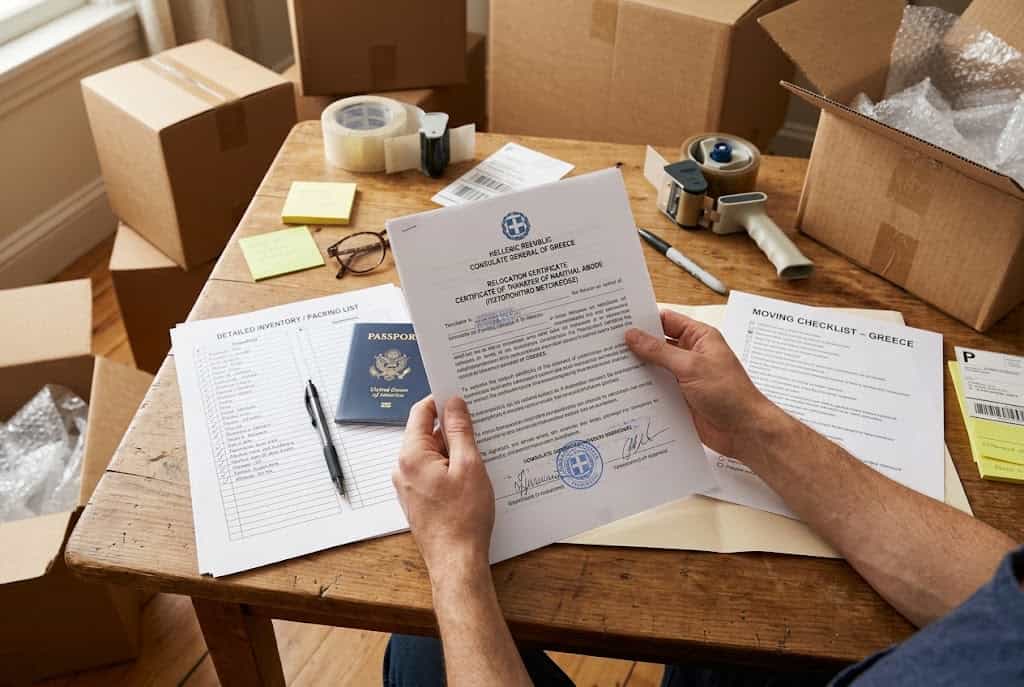
That means your passport, proof of residence, valued inventory, non-resale declaration, and change of residence documentation all need to tell the same story, with no contradictions in timing, address, or intent. A single strong document, like a change of residence certificate, will not override weaker supporting documents elsewhere in the file. When everything aligns, clearance is routine. When it doesn’t, customs pauses the process to request clarification, and your shipment stays under customs control while you sort it out.
When we prepare your file, we translate and label documents the way French customs officers expect to see them, and we align your shipping timeline with document validity, since some proofs are time sensitive.
Proof of Residence: Why Intent Is Not Enough
Proof of residence is one of the most frequently misunderstood requirements. Many movers assume a signed lease or planned housing arrangement is enough. French customs generally disagrees: officers want proof you are actually establishing residence, which usually means a lease, proof of ownership, or formal accommodation documentation already in effect or imminently valid at the time of clearance.
Timing matters here. A lease that starts weeks after your shipment arrives can raise questions. Address inconsistency is another common issue: if your proof of residence lists one address while other documents reference another, even within the same city, customs may ask for clarification.
The Valued Inventory: A Credibility Check, Not Just a Packing List
French customs relies on a valued inventory to understand what is in your shipment, and treats it as a credibility check, not just a transport record. Officers aren’t looking for replacement value, they’re checking whether declared values make sense for used personal belongings moved as part of a residence transfer. Values should reflect second-hand worth, not retail pricing, and an inventory that reads too high or implausibly low can each raise questions in their own way.
The list should be organized by room or box, signed and dated by you, and clear enough that vague descriptions or grouped high-value categories don’t slow things down. Our team can provide a bilingual template and help you structure it so it reads like a realistic snapshot of a lived-in home. If you’re shipping wine collections, musical instruments, artwork, or antiques, flag them clearly on the list with any certificates or provenance notes you hold.
The Non-Resale Certificate and the 12-Month Rule
France allows household goods to enter duty-free under a change of residence exemption with one major condition: the goods cannot be sold, transferred, or disposed of for a defined period after import, typically twelve months. The non-resale certificate, sometimes called a non cession, formalizes this by declaring the goods are for your personal use and will remain in your possession during that period.
Customs takes this declaration seriously because the exemption exists to support genuine relocations, not the import of goods for resale. Violations can result in retroactive duties and penalties even after delivery. We supply a ready-to-sign version and make sure your signature and dates match your other documents, since the certificate needs to align with your inventory and residency narrative to hold up.
Proving Your Change of Residence
To qualify for duty relief, you must show you are transferring your normal place of residence to France. An employer transfer letter on company letterhead works well if you’re relocating for work. If you’re moving for family or retirement, proof of French housing plus evidence of ending your U.S. lease or selling your U.S. home does the same job. We format these in a standard way so the reviewing officer can understand your situation in minutes.
Proof That Your Goods Are Used
Duty relief also requires showing your items have been in your possession for a period before import, typically six months. You don’t need receipts for every plate or pillow, just the general age of major items when asked. Purchase years in your valued inventory for big items like sofas and TVs, or a settings screenshot showing a phone or laptop’s purchase date, usually covers it.
Small Inconsistencies That Quietly Delay Clearance
One of the most frustrating causes of delay is inconsistency across documents, and these issues are rarely dramatic on their own: a spelling variation between your passport and another document, a missing middle name, dates that don’t quite line up. Individually they seem small. Collectively, they can slow clearance while customs seeks confirmation, and your shipment stays under customs control while you sort it out.
The goal isn’t a perfect file, it’s an internally consistent one, where every document reinforces the same identity, address, and timeline.
Shipping a Vehicle in the Same Container
If you plan to include a car or motorcycle in the same container as your household goods, there are extra documents to add: your original title, a copy of your registration, and identity documents that match the titleholder, plus proof of ownership length and any compliance documents customs requests. SDC can ship vehicles when they’re containerized with household goods, and we’ll guide you through the additional steps, including any technical inspection required after arrival. Our page on container versus RoRo vehicle shipping explains how the options compare before you talk to your coordinator about the right approach for your car.
What Happens When Documents Are Missing or Weak
When customs identifies a weakness in your file, the process pauses while questions are raised or additional evidence is requested. Your shipment isn’t released during that pause, storage and handling charges may start to accrue, and in rare cases customs may reassess whether the shipment qualifies for duty-free entry at all. Getting your professional packing inventory and paperwork built in parallel, well before your sailing date, is the single biggest thing you can do to avoid this.
Insurance That Matches Your File
Customs clearance and insurance are related more than most people realize. A well-prepared valued inventory supports your international moving insurance, and your policy terms guide how we record high-value items on your inventory. Good documentation protects your move twice: first at customs, then in the rare event of a claim.
Timelines, Storage, and Staying Compliant
Sometimes the date you can move out doesn’t match the date you can receive delivery in France. We bridge that gap with climate-controlled storage at origin or destination, keeping your document dates aligned so your duty relief stays intact. Most ocean shipments to France run roughly six to twelve weeks door to door for direct service, and eight to sixteen weeks for groupage, with West Coast departures trending toward the longer end. We’ll give you a route-specific estimate and keep your paperwork timed to the actual sailing.
How SDC Guides You Through Each Step
We begin with a short call to map your move and confirm what documents you already have, then send your tailored document kit, including a bilingual valued inventory, the non-resale statement, and a transfer letter sample your employer’s HR can adapt if needed. When packing day arrives, our crew completes a detailed inventory that mirrors your valued list, and we assemble your customs file and submit it to our French clearance partner, with one coordinator keeping your paperwork on track from pickup to delivery.
Your Checklist for a Smooth Clearance
Every France move is a little different, but the winning formula is consistent: a clear identity set, a complete relocation proof set, a signed non-resale statement, and a bilingual valued inventory that matches your shipment. Add professional packing, properly timed shipping documents, and insurance that fits your plan, and customs becomes a short checkpoint on the way to your new life.
If you want a specialist to make the paperwork simple, call SDC International Shipping at 877-339-0267 and we’ll build your document kit and timeline so your move clears customs cleanly and arrives ready for delivery.