

RoRo vs. Container Shipping: Which is Better for Your Car?
Last Updated: April 2026
When shipping a car internationally, the two methods most commonly compared are Roll-on/Roll-off (RoRo) and container shipping. Understanding how each method works, and where the real differences lie in security, cost, customs, and destination access, helps you make an informed decision before booking.
SDC exclusively uses container shipping for all vehicle moves and always recommends shipping a vehicle inside a container alongside household goods rather than as a standalone shipment. This page explains the reasoning in plain terms. For an overview of SDC’s full door-to-door relocation service, SDC International Shipping handles vehicle and household goods moves from all 50 US states.
What Is RoRo Shipping?
RoRo stands for Roll-on/Roll-off. It is a method of ocean freight designed specifically for wheeled vehicles. Cars, trucks, and other wheeled cargo are driven directly onto the vessel under their own power, secured in open deck bays, and driven off at the destination port. The vehicle is exposed to the elements throughout transit and handled by port workers at both ends.
RoRo vessels operate on fixed routes between major ports. Not every destination has a RoRo-capable port, and the method only works for vehicles that are in running condition. It is a vehicle-only service and cannot be combined with a household goods shipment under the same customs file.
How RoRo and Container Shipping Actually Work
RoRo works like a ferry for vehicles. Cars are driven onto the vessel, secured in an open deck bay, and driven off at the destination port. The vehicle is exposed throughout transit and accessible to port handlers at both ends.
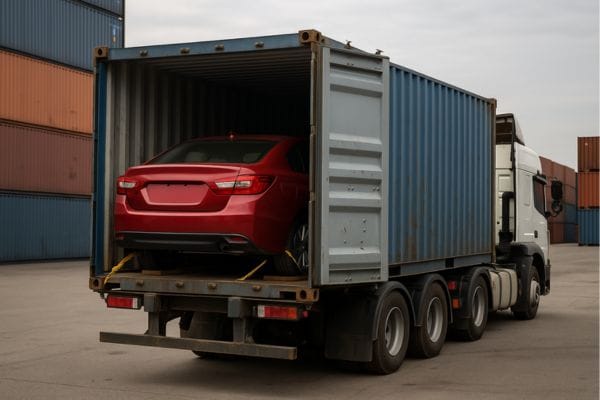
Container shipping places the vehicle inside a sealed steel container, typically a 20ft or 40ft dry container, which is then loaded onto a cargo vessel. The container is locked from the point of loading at the origin warehouse until it is opened by the consignee at the destination. Nothing is exposed during transit. For moves that also include household goods, the vehicle and personal effects travel in the same container under a single export and import file, which simplifies customs documentation significantly.
Vehicle Security and Insurance
Container shipping is meaningfully more secure than RoRo for several reasons. The sealed environment eliminates exposure to salt spray, weather, and the handling that occurs when vehicles are driven on and off a vessel. In a container, the only people who interact with the vehicle are the loading team at origin and the consignee at destination. In RoRo, port workers at both ends drive the vehicle on and off the ship, and the car sits on an open deck for the full duration of transit.
Insurance reflects this difference. Comprehensive all-risk policies are more straightforward to write for sealed container shipments because the risk profile is cleaner. RoRo policies often carry exclusions or limitations tied to exposure and handling. For high-value vehicles, classic cars, or vehicles with modifications, container shipping is the only method SDC recommends.
When a vehicle ships inside a container alongside household goods, SDC’s international moving insurance covers the entire load, vehicle and personal effects, under a single policy, which is simpler to manage and typically more cost-effective than separate coverage.
Cost: When Container Shipping Is More Economical Than It Looks
RoRo is typically less expensive than a dedicated container for a vehicle-only shipment. That comparison changes when the vehicle is moving as part of a household relocation. When a car is loaded into the same container as household goods, the container cost is shared across the full shipment, and the savings from consolidating everything into one move, with one customs file and one set of origin and destination handling fees, often make container shipping more economical overall than the headline price suggests.
For vehicle-only shipments, shared container options exist where up to four vehicles share a single container and split the cost. This brings the price closer to RoRo while retaining the security and customs advantages of container shipping. East Coast origins are generally less expensive than West Coast for transatlantic routes due to shorter ocean distance. Seasonal demand and fuel surcharges also affect final pricing. Your SDC coordinator can provide a current quote based on your specific origin, destination, and timeline.
Transit Times
RoRo has a timing advantage on certain high-frequency routes because vehicles can be rolled onto the next available departure without waiting for a container to be filled. For shared container shipments, there may be a consolidation wait before departure.
In practice, the difference is smaller than it sounds for planned relocations. SDC schedules container departures regularly on major corridors, and for full household moves the container timeline is typically set around the client’s move date rather than vessel availability. Typical ocean transit times: US to Europe runs 12 to 25 days depending on origin port and destination; US to Asia runs 18 to 35 days. These ranges apply to both RoRo and container on comparable routes.
Non-Running Vehicles
RoRo requires the vehicle to be driven on and off the vessel under its own power. If your car is not in running condition, due to mechanical issues, damage, or the nature of the vehicle, RoRo is not an option. Container shipping accommodates non-running vehicles using forklift loading at the warehouse. SDC handles non-running vehicle shipments routinely and can advise on any additional bracing or preparation required.
Vehicle Size and Type
Standard 20ft and 40ft dry containers accommodate most sedans, SUVs, and pickup trucks. A 20ft container can typically hold one standard vehicle alongside personal effects. A 40ft container provides more room for larger vehicles or for combining a vehicle with a fuller household goods shipment. Oversized vehicles, large trucks, modified vehicles, or commercial equipment may require open-top or flat-rack containers depending on dimensions.
Electric vehicles require specific preparation before container loading: the battery charge level must be within a specified range, typically 20 to 30%, and certain documentation about battery type and capacity is required by most shipping lines. SDC coordinators who handle EV shipments regularly can walk through the preparation checklist for your specific vehicle make and model before the loading date.
Destination and Port Availability
RoRo services operate on fixed routes between major ports. Not every destination has a RoRo-capable port, and for destinations served only by general cargo vessels, container shipping is the only viable method. Even where RoRo is technically available, the nearest RoRo port may not be close to your final delivery address, adding inland transport cost and complexity that containers avoid.
Container shipping reaches virtually any international port with general cargo handling. For island destinations, remote coastal locations, or countries with limited port infrastructure, containers offer routing flexibility that RoRo cannot match. This is one of the primary reasons SDC uses containers exclusively: the service works regardless of destination.
Shipping Your Vehicle with Household Goods: How It Works at SDC
The most practical way to ship a vehicle internationally, for clients who are also relocating their household, is to load the car into the same container as the household goods. This is SDC’s standard approach and offers several concrete advantages beyond security.
First, customs documentation is consolidated. Rather than managing separate export and import files for a vehicle and a household goods shipment, everything moves under one bill of lading. This reduces paperwork, simplifies the customs clearance process at the destination, and lowers the risk of documentation discrepancies between two separate shipments arriving at different times.
Second, the vehicle can carry items inside it. Unlike RoRo, where vehicles must be empty, container shipments allow personal effects to be packed inside the car, typically soft goods, clothing, or lightweight items that don’t require separate crating. This makes use of otherwise unused space inside the vehicle and can reduce the total container volume needed.
Third, the vehicle is braced inside the container using purpose-built wheel chocks and straps secured to the container floor. It does not move during transit. SDC’s loading teams handle this at the origin warehouse as part of the standard packing process; clients do not need to arrange separate vehicle preparation.
For the household goods side of your move, SDC’s professional international packing service covers export-grade packing, loading, and container preparation, with the vehicle included in the same shipment.
Frequently Asked Questions
What does RoRo mean in shipping?
RoRo stands for Roll-on/Roll-off. It refers to a method of ocean freight where wheeled vehicles are driven directly onto a vessel and secured in open deck bays for transit. The name describes how the cargo enters and exits the ship. RoRo is a vehicle-only service and is not available at every international port.
What is the difference between RoRo and container shipping?
In RoRo, vehicles are driven onto an open vessel deck and exposed throughout transit. In container shipping, the vehicle is sealed inside a steel container and remains locked from origin to destination. Container shipping offers better security, works for non-running vehicles, accommodates household goods in the same shipment, and reaches a wider range of international ports.
Why doesn’t SDC offer RoRo shipping?
SDC’s service model is built around complete household relocations. Container shipping is the only method that allows a vehicle and household goods to move together under one customs file. RoRo is a vehicle-only service that doesn’t integrate with a full household move, and the security trade-offs don’t align with the standard SDC sets for client shipments.
Can I ship a car to any country by container?
Container shipping reaches any country with general cargo port access, which is virtually every international destination SDC serves. Your coordinator can confirm port options and inland delivery arrangements for your specific destination.
How long does international car shipping take?
Ocean transit to Europe typically runs 12 to 25 days from the US; to Asia, 18 to 35 days. Add time for origin warehouse preparation and destination customs clearance, which varies by country. Your SDC coordinator will give you a realistic door-to-door timeline based on your specific route.
What documents do I need to ship a car internationally?
Standard documentation includes the original vehicle title showing your name, a copy of your passport, and destination-specific import documents that vary by country. Some destinations require proof that the vehicle has been owned for a minimum period, typically six months, to qualify for duty-free importation as a personal effect. SDC coordinates the full documentation package with you before the shipping date.
Ready to get a quote?
Request a shipping quote here and an SDC coordinator will follow up to discuss your vehicle type, destination, and timeline.