

Can I Ship My Car with Household Goods When Moving to Italy?
If you’re planning a move to Italy from the USA and you own a vehicle you’d like to bring along, this is one of the more practical questions to sort out early. The short answer is yes, you can ship a car to Italy alongside your household goods, and in most cases, doing it together in a single container is more efficient than shipping them separately. But there are real conditions to meet, and Italy’s customs requirements for imported vehicles are specific enough that it pays to understand them before you book anything.
This guide is for people moving their primary residence to Italy from the United States. It covers how vehicle shipping works alongside a household goods move, what documentation Italian customs will require, and what to expect in terms of timing and costs. If you are looking to import a car to Italy without a household goods move, or to purchase a vehicle at auction, this post is not written for that situation.
SDC International Shipping is a licensed door-to-door moving company serving all 50 US states, and we handle combined household goods and vehicle shipments to Italy regularly. Here is what our coordinators tell clients who ask about bringing their car along.
Can You Ship a Car and Household Goods Together to Italy?
Yes, and this is typically how we recommend doing it. When a car is shipped in the same container as household goods, you get a single shipment, a single customs entry, and one customs clearance process at the Italian port of arrival. This is more cost-effective than two separate shipments and reduces the coordination burden on the client.
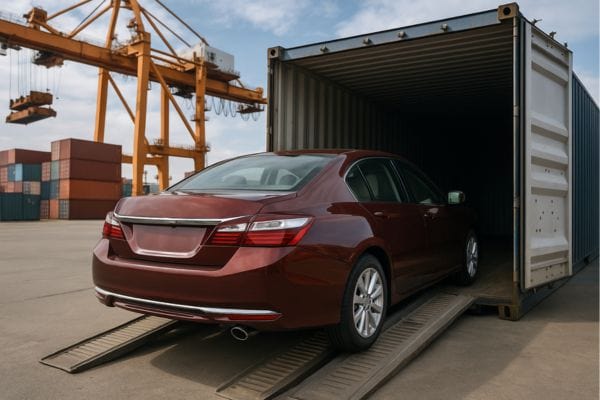
The vehicle is loaded into the container first, positioned at the rear, and then household goods are packed around and in front of it. Depending on the vehicle size and the volume of household goods, a 20-foot or 40-foot container may be used. For clients with a large vehicle like an SUV or pickup truck, a 40-foot container is usually required to accommodate both the car and a reasonable volume of household goods.
We always recommend containerized car shipping over RoRo (roll-on, roll-off) when the vehicle is moving alongside household goods. RoRo is a separate service on a different vessel, and it does not allow household goods to be included. RoRo also leaves the vehicle exposed to weather and handling on the ship’s vehicle deck. Container shipping gives the car consistent protection throughout the voyage.
What Does Italy Customs Require to Import a Personal Vehicle?
Italy follows EU Transfer of Residency (ToR) rules for importing personal vehicles duty-free as part of a household goods move. The exemption is real and substantial, but you must qualify for it. The main conditions are as follows.
You must have been living outside the European Union for at least 12 consecutive months prior to your move to Italy. This is the residency threshold that triggers ToR eligibility for the entire shipment, including the vehicle.
You must have owned and regularly used the vehicle for at least six months before the date of shipment. Italian customs will look at registration documents, insurance records, and purchase invoices to verify this. A vehicle purchased shortly before moving will not qualify for duty-free entry.
The vehicle must arrive in Italy within 12 months of your own transfer of residence date. Vehicles cannot be sold, lent, or otherwise disposed of for 12 months after importation. If you sell the vehicle within that period, you will owe the duties and VAT that were waived at entry.
For the vehicle specifically, the customs documentation package typically includes:
- Original certificate of title in your name
- Original vehicle registration from the USA
- Purchase invoice or bill of sale, dated at least six months before shipment
- Insurance records demonstrating personal use in the USA
- Passport and proof of change of residence to Italy
- A valued inventory that includes the vehicle’s year, make, model, VIN, engine size, and odometer reading
Your destination agent in Italy will prepare and submit the customs entry. This is not something you file yourself. Having your documents organized and ready before the shipment departs the USA is what keeps the clearance process on schedule.
Will an American Car Pass Italian Technical Inspection?
This is the question that trips people up most often, and it deserves a direct answer. Italian road registration requires a vehicle to meet EU technical and emissions standards. American vehicles are manufactured to US standards, which differ in several respects from EU standards, including headlight configuration, speedometer display, and emissions compliance.
Before a US-spec vehicle can be registered and driven legally in Italy, it typically must undergo an inspection and in some cases a technical modification process called omologazione, which is essentially a type approval or compliance certification for vehicles not originally built to EU standards. Depending on the vehicle’s age, make, and model, this process can range from straightforward to expensive. Some older vehicles or certain American models are more complex to register than others.
We strongly recommend that clients research the specific omologazione requirements for their vehicle before deciding to ship it. In some cases, the cost and complexity of bringing a vehicle into Italian road compliance makes it more practical to sell the US vehicle before the move and purchase a locally registered vehicle in Italy instead. We are not able to advise on compliance costs for specific vehicles, but your destination agent in Italy will be able to point you toward the right inspection facility.
How Long Does Combined Shipping Take?
Ocean transit from the US East Coast to Italy typically runs 14 to 21 days. From the US West Coast, add roughly a week. Customs clearance in Italy generally takes an additional one to three weeks once the container arrives at port, depending on documentation completeness and the current processing volume at the port of entry.
Total door-to-door time for a combined household goods and vehicle shipment from the USA to Italy typically ranges from six to ten weeks, depending on origin, port, and customs processing. We always quote timelines as ranges rather than fixed dates, because factors like port congestion, vessel scheduling, and customs staffing can shift delivery windows. Clients who need the car specifically should factor this into their planning and consider whether they will need a rental vehicle in Italy while the shipment clears.
What About Fuel and Vehicle Preparation?
Before loading, the fuel tank must be reduced to no more than one quarter full. This is a safety requirement for ocean container shipping, not an Italian customs rule. The battery is typically disconnected for the voyage. If the vehicle has an alarm system, your coordinator will walk you through how to handle that before pickup.
Personal items should not be left inside the vehicle during shipping. Italian customs has the right to inspect the vehicle, and items inside it may complicate the clearance process or require separate declaration. Household goods should be packed in the main body of the container, not in the car.
Is It Worth Shipping a Car to Italy?
For most clients moving from the USA to Italy, the honest answer depends on the vehicle. If you have a relatively new, high-value vehicle that you are attached to and it will clear EU technical compliance without significant modification costs, bringing it along as part of your household goods container makes financial and logistical sense. If you drive an older vehicle or one that is difficult to certify for Italian road use, selling it in the USA and replacing it locally is often the more practical path.
Our coordinators can walk you through the logistics of including your vehicle in your container. The packing and loading process for a combined household goods and vehicle container requires advance planning on dimensions, container type, and scheduling, so the earlier you raise it, the more options you will have.
Frequently Asked Questions
Can I ship more than one vehicle with my household goods to Italy?
The Transfer of Residency exemption in Italy covers one vehicle per qualifying person. If you are a couple both qualifying under ToR and moving together, two vehicles may qualify, but each must independently meet the six-month ownership and use requirement. Shipping two vehicles in one container with household goods is logistically complex and usually requires a 40-foot high-cube container at minimum. Discuss this scenario with your coordinator early.
Does my car need to arrive at the same time as my household goods?
If they are in the same container, they arrive together by definition. If you ship the vehicle separately or at a different time, it must still arrive within 12 months of your residence transfer date to qualify for duty-free entry. Coordinating the timing is something your shipping coordinator will help you plan.
What if I do not qualify for the duty-free Transfer of Residency exemption?
If you have not lived outside the EU for 12 consecutive months, or if the vehicle does not meet the six-month ownership threshold, you will owe Italian import duties and VAT on the vehicle’s declared value. EU import duties on vehicles from the USA are currently around 6.5%, and Italian VAT adds 22% on top of the dutiable value. On a $30,000 vehicle, that can add up to a meaningful cost. It is worth calculating this against the local purchase cost of a comparable vehicle in Italy before committing to the shipment.
Can SDC ship just my car to Italy without household goods?
SDC’s primary service is household goods moves. For vehicle-only shipments, the logistics are different and the service is structured differently. If you are moving to Italy and want to include a vehicle, talk to your coordinator about combining it with your household goods move, which is where the logistical and cost advantages are strongest.