What Is a Certificado de Bagagem and Do I Need One?
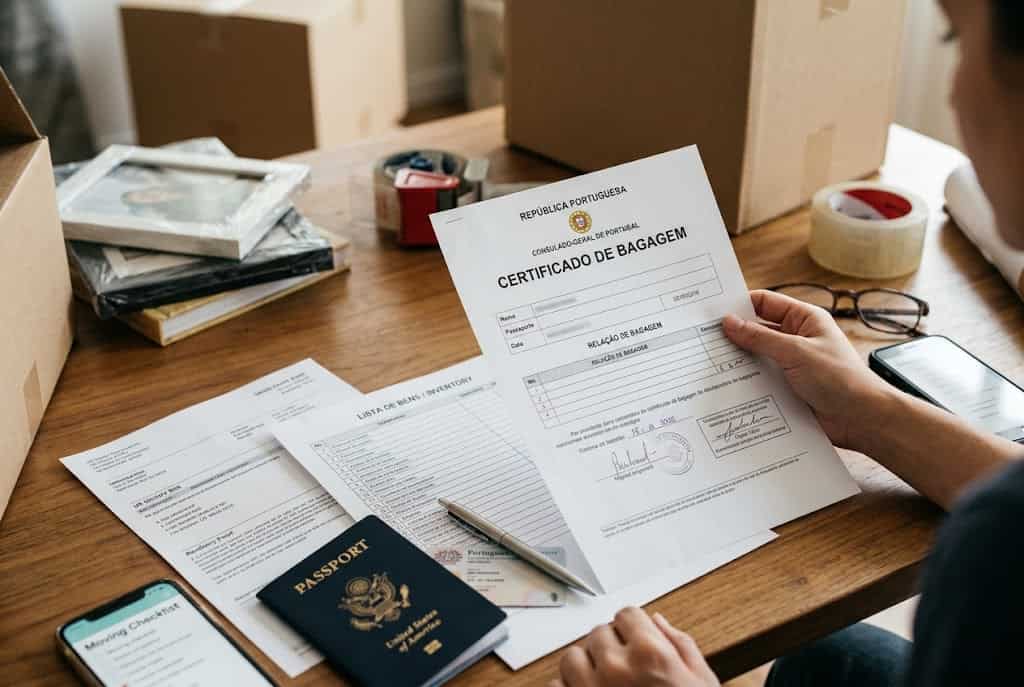
Most of the paperwork for a move to Portugal can wait until you land. The Certificado de Bagagem cannot. It comes from a Portuguese consulate in the United States, and your container’s customs clearance in Portugal depends on having the stamped original in hand.
This article is for Americans moving their primary residence to Portugal and shipping household goods by sea. A single parcel or a commercial import follows different rules.
SDC International Shipping is an international shipping company serving all 50 states, and we handle household goods moves to Portugal regularly. Below is what our coordinators walk every client through, whether you are headed to Lisbon, Porto, the Algarve, or somewhere in between.
What the Certificado de Bagagem Is
The name translates literally as “baggage certificate.” It is issued by the Portuguese consulate with jurisdiction over where you live in the US, usually by mail, and it records that you are transferring your residence to Portugal and that the goods are used personal effects. It is Portugal’s version of the EU transfer-of-residence relief that France, Germany, and Italy also apply under their own names.
The certificate is what lets your goods enter duty-free. Without it, customs can treat your shipment as an ordinary import, with duties and Portuguese VAT of 23% charged on its value. Your destination agent presents the certificate, together with your valued inventory, when the container is cleared.
Who Qualifies
- You have lived outside the European Union for at least 12 consecutive months before the move.
- The goods are non-consumable items you have owned and used for at least six months before you ceased residence outside the EU.
- Portugal is becoming your normal, primary home, not a vacation address.
- The goods are declared for free circulation within 12 months of establishing residence in Portugal. Multiple shipments are allowed inside that window.
- You do not sell, lend, or hire out the goods for 12 months after import.
D7 and D8 visa holders generally qualify if they meet those conditions. Non-EU citizens, which includes most Americans, also need the Portuguese residence visa to apply. Time spent living in another EU country counts against your 12 months, so tell your coordinator early if you spent part of the past year in France or Spain.
A caution on the six-month rule: some consulates ask for invoices or other proof that the goods are older than six months, and a few older guides cite one year. Check what your consulate asks for before you assume.
How to Get the Certificate
- Find your consulate. Portugal assigns consular jurisdiction by where you live in the US, so the right office depends on your state.
- Lock in your Portuguese address. The application needs proof of a Portuguese address, ideally a signed lease or a deed. A promissory purchase contract is sometimes accepted but is weaker.
- Assemble the package. Expect to provide a copy of your passport (and your Portuguese residence visa if you are not an EU citizen), proof of 12 or more months of residence outside the EU such as utility bills, a lease, tax records, or a driver’s license, the consulate’s application and declaration form, and a signed inventory list in triplicate.
- Mail it with the fee and a prepaid return envelope. The fee and the format vary by consulate, so confirm both on its website.
- Wait for the stamped original. Processing can take several weeks, and the length varies. Ask the consulate for its current lead time before you set a sailing date.
Your NIF (Portugal’s tax identification number) is not required for the consular certificate itself. It is essential for customs clearance, though, so start it early.
Two Inventories, Two Jobs
The inventory you sign for the consulate is a plain list of what you are bringing, in triplicate, showing your transfer date and Portuguese address. It typically carries no values. The consulate stamps it and attaches it to your certificate.
Customs needs a second document: a valued inventory in euros, preferably in Portuguese or with a translation. Our coordinators build the detailed packing list and the valued inventory from your origin inventory during the packing and survey process. If the paperwork does not match what is actually in the container, clearance slows down, so we pack to the list rather than the other way around.
Why Timing Decides the Whole Move
The certificate has to be available by the time the container arrives, and a missing or late one is among the most common reasons Portuguese clearance stalls. Work backward from the sailing: sign the lease, start your NIF, apply for the certificate, and only then lock a sailing date.
The address matters twice, once for the consulate and again for customs release. If it is not settled when the container lands, the shipment goes into storage at the port and charges start. If your lease is not signed yet, holding your belongings in storage at origin keeps the container from landing before you can receive it.
How Long Clearance Takes
With complete documents, clearance at Lisbon or Leixões typically takes one to three weeks. The regular causes of delay are a missing or late certificate, no NIF, an inventory that does not match the container, a missing Portuguese translation, incomplete proof of address, and physical inspections. Summer is slower because of higher shipment volume, so a May-to-September arrival deserves extra buffer.
Ocean transit from the US East Coast is roughly 10 to 16 days. Door to door, plan on about 6 to 10 weeks for a full container and 8 to 12 for a shared one. These are planning ranges, not guarantees, and they assume the paperwork is in order.
When Some of Your Goods Do Not Qualify
Items under the ownership threshold, things bought new for the move, and anything outside the personal-effects category can be assessed standard EU duty plus 23% VAT. Our guide to shipping household goods to Portugal covers restricted items, ports of entry, and vehicles.
Frequently Asked Questions
Can my destination agent get the certificate for me?
No. You obtain it from the Portuguese consulate that covers your US residence. The agent in Portugal uses the stamped original to clear your goods, and SDC helps with timing, the documents, and the inventories.
Do I need it for a few boxes?
Yes. Volume does not change the requirement. A pallet of boxes and a 20-foot container need the same paperwork if you want duty-free entry.
Can I send more than one shipment?
Yes, as long as every shipment is declared for free circulation within the 12-month window after you establish residence in Portugal. Tell your coordinator about a second shipment at the start, not after the first clears.
What if I have no permanent address yet?
Get at least a short-term lease before you apply and before the container sails. A signed lease works better than a promise to buy. Without an address, the consulate cannot process your application and customs will not release your goods.
Is this the same as the transfer-of-residence process in other EU countries?
The underlying relief is similar, but each country runs its own paperwork. Portugal’s version starts with a consulate in the US, which surprises people who have moved to France or Germany before.
Planning a move to Portugal? Send us your US state, whether your Portuguese address is settled, and the date you want to be there. We will tell you which consulate to contact and how to sequence the certificate with the sailing. Call 877-339-0267 or request a quote.