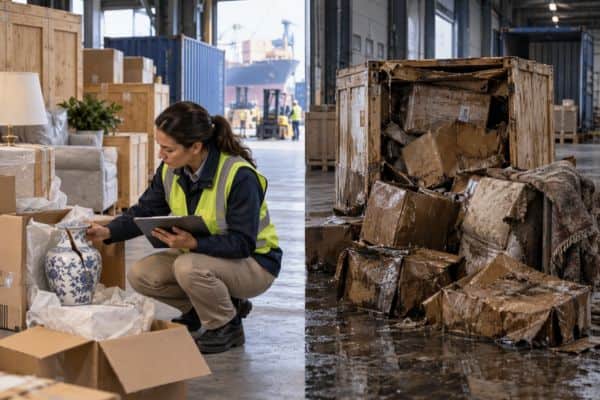

A Guide to Professional Packing Services
Packing for an International Move
*Updated January 2026
Packing for an international move is one of the most underestimated parts of relocating overseas. What works for a local or domestic move often fails when your household goods must travel thousands of miles, pass through ports, clear customs, and withstand weeks of transit.
If you’re comparing international movers and want a clear door-to-door process that accounts for these realities, start with our international moving company overview.
At SDC International Shipping, packing is not treated as a standalone task. It is an integrated part of the international moving process, designed to protect your belongings through long transit times, multiple handling points, and varying climate conditions. This guide explains why professional international packing matters, how it differs from domestic packing, and what to expect when your shipment is prepared correctly for overseas transport.

Why Packing for an International Move Is Different Than a Local Move
Many people assume packing is packing, that if items are wrapped and boxed, they are ready to ship anywhere. International moving proves otherwise. Overseas shipments face conditions that simply do not exist in local or even cross-country moves, and packing must be planned accordingly.
When your household goods move internationally, they are typically packed days or weeks before departure, loaded into shipping containers, transported to ports, lifted by cranes, stacked on vessels, and then handled again at destination ports. Along the way, shipments may be exposed to vibration, compression, humidity, temperature changes, and customs inspections. Each of these stages introduces risk if packing is not done correctly.
Unlike a local move where items are loaded once and unloaded once, international shipments may be handled multiple times. Consolidated or groupage shipments, which are common for smaller household moves, add another layer of complexity because your goods share container space with other shipments. Packing must account for potential movement within shared containers and longer dwell times at ports.
Transit time is another major difference. Domestic moves usually take days. International moves often take weeks. Ocean freight shipments can remain sealed in containers for extended periods, especially during peak shipping seasons or customs processing delays. Packing materials and methods must be selected with this duration in mind, including resistance to moisture buildup and pressure from stacked cargo.
Climate exposure is also a critical factor. Shipments may move through hot, humid ports, cross cold ocean routes, or sit in varying environments before final delivery. Standard household packing materials are not designed for this level of exposure. Export-grade materials and techniques help reduce the risk of mold, warping, corrosion, and surface damage.
The Risks of Improper Packing for Overseas Shipments
Improper packing is one of the most common causes of damage during international moves. While many issues may not be visible at origin, problems often reveal themselves weeks later, when the shipment arrives overseas and cartons are opened for the first time.
Unlike domestic moves, international shipments are exposed to prolonged transit times, heavy stacking pressure inside containers, and environmental changes that test the limits of packing materials. Boxes that look fine when loaded can collapse, shift, or absorb moisture during the journey if they are not prepared for export conditions.
One of the most common issues we see with improperly packed shipments is internal shifting. As containers move across ocean routes, constant vibration causes loosely packed cartons to settle. When items are not packed firmly, contents can shift downward, creating empty space at the top of boxes. Over time, this leads to crushed cartons, broken contents, and damaged furniture.
Compression damage is another frequent risk. Shipping containers are designed to carry significant weight, and cartons are often stacked tightly together. Household goods packed with lightweight or non-export-grade boxes may not withstand this pressure. Even sturdy furniture can suffer damage when weight transfers unevenly through poorly packed loads.
Moisture exposure is a hidden but serious threat in international shipping. Ocean containers are subject to condensation as temperatures fluctuate during transit. Without proper wrapping, padding, and ventilation planning, moisture can lead to mold growth, warped wood, corrosion on metal surfaces, and damage to fabrics and electronics.
Another overlooked risk comes from customs inspections. Customs authorities in many countries may open cartons to verify contents. Boxes that are poorly packed or overfilled are more likely to be disturbed during inspection. When items are not packed systematically, they may not be repacked with the same care, increasing the chance of breakage before final delivery.
Do-it-yourself packing and packing designed for local movers often fails in international scenarios. Standard household boxes, reused cartons, and minimal padding simply are not designed for extended international transit. Even well-intentioned packing can fall short when materials and methods are not matched to overseas shipping conditions.
Improper packing can also affect your ability to protect your shipment financially. Many international moving insurance policies require professional packing or documented packing standards to fully cover damage claims. When packing does not meet these standards, claims may be reduced or denied, leaving customers responsible for repairs or replacements.
For these reasons, packing should never be treated as an afterthought in an international move. It is a foundational element that influences shipment safety, insurance protection, customs handling, and the overall success of your relocation.
The Importance of Professional Packing for Household Goods
Professional packing is not about convenience alone, it is about engineering your shipment to survive international transit. Household goods moves overseas place unique demands on packing methods, materials, and planning, and these demands are rarely met by standard packing approaches.
When packing is done by professionals experienced in international relocations, every decision is intentional. From the type of carton used to the way weight is distributed inside each box, packing is designed to protect your belongings over long distances, extended timelines, and repeated handling.
Protecting Fragile and High-Value Items
Fragile items are often the first casualties of improper international packing. Glassware, ceramics, artwork, antiques, and electronics require more than simple wrapping. They must be immobilized within cartons, cushioned against shock, and separated from heavier items that could cause compression damage.
Professional packers use layered protection strategies, combining wrapping, padding, and structured placement within cartons. Items are packed to prevent internal movement, not just to avoid surface contact. This approach significantly reduces the risk of breakage, even when cartons are shifted or briefly tilted during handling.
For particularly delicate or valuable belongings, professional packing may include reinforced cartons or custom crating. This level of protection is especially important for items with irregular shapes or high replacement value.
Export-Grade Materials Versus Domestic Packing Supplies
One of the biggest differences between professional international packing and do-it-yourself packing is the quality of materials used. Export-grade cartons, wraps, and padding are designed to withstand extended transit, stacking pressure, and environmental exposure.
Domestic moving boxes, reused cartons, and retail packing supplies are rarely engineered for these conditions. Over time, lighter materials can weaken, collapse, or absorb moisture. Professional packing materials are selected specifically to reduce these risks and maintain structural integrity throughout the journey.
Using the correct materials is not about overpacking, it is about matching the protection level to the realities of international shipping. This balance helps safeguard your belongings without unnecessarily increasing shipment volume.
Space Optimization Without Compromising Safety
Efficient use of space is important in international moves, but it must never come at the expense of protection. Professional packers understand how to build stable loads that maximize container space while maintaining proper weight distribution and structural support.
Furniture is often disassembled to reduce volume and wrapped to protect surfaces. Smaller items may be nested strategically, but only when doing so does not increase the risk of damage. The goal is a balanced, secure shipment that resists movement during transit.
Saving Time During an International Relocation
International moves involve far more than packing alone. Visas, housing arrangements, employment transitions, and travel logistics all compete for your time and attention. Professional packing allows you to focus on these priorities while experienced crews handle the physical preparation of your shipment.
Professional teams also work efficiently and systematically. Items are packed in logical groups, labeled clearly, and documented in inventories that support smoother customs processing and easier unpacking at the destination. This organization reduces stress both before departure and after arrival.
Our Professional Packing Process for International Moves
Professional packing for an international move is not a single action; it is a coordinated process that begins before packing day and continues until your shipment is ready for export. At SDC International Shipping, packing is integrated into our household goods moving services. Your belongings are prepared correctly for transit, customs, and final delivery.
Every international move starts with an assessment. Before packing begins, we review the size of your shipment, the destination country, and whether your move will travel by air freight or sea freight. These factors directly influence packing materials, carton strength, and protection levels.
Once the packing plan is established, our team arrives with export-grade materials designed for international transport. This includes reinforced cartons, protective wraps, and specialty supplies used for artwork and other high-value items that require additional care.
Packing is completed systematically. Items are grouped by type and weight, voids are eliminated inside cartons, and furniture is protected or disassembled when needed. This approach supports safe loading into international shipping containers and reduces movement during long ocean transits.
As items are packed, detailed labeling and inventories are created to support customs processing and destination delivery. This documentation also plays a role in international moving insurance, helping establish the condition and contents at the origin.
For shipments that require holding before departure or after arrival, packing is coordinated with climate-controlled storage goods remain protected even if timelines change.
Packing Specialized Items for International Shipping
Not all household goods face the same risks during an international move. Certain items require specialized packing techniques due to their fragility, value, size, or sensitivity to environmental changes. Identifying these items early allows packing methods to be adjusted before shipment begins.
Artwork, antiques, and decorative pieces are among the most vulnerable items in overseas transit. These items often have irregular shapes, delicate surfaces, or materials that can crack, warp, or fade if exposed to pressure or moisture. Professional packing focuses on immobilizing these pieces, protecting surfaces, and isolating them from heavier items during transport.
For shipments that include fine art or high-value personal items, packing may involve reinforced cartons or custom-built crates designed specifically for the item’s dimensions and weight. This level of preparation is especially important when shipping items that are difficult or impossible to replace, and it is commonly coordinated with specialized artwork and valuables shipping services.
Electronics also require careful attention. Long transit times and fluctuating temperatures can affect sensitive components if items are not packed correctly. Professional packing ensures electronics are cushioned, secured to prevent movement, and protected from static or pressure damage during the journey.
Furniture presents a different challenge. Large pieces may need to be partially disassembled to reduce stress points and improve stability inside the container. Surfaces are wrapped to prevent scratches, and components are packed to avoid shifting. This approach helps preserve both function and appearance upon arrival.
Some international moves also include vehicles shipped alongside household goods. While SDC does not offer car-only shipping, vehicles can be safely transported when properly prepared and secured within containers that also carry personal belongings. In these cases, packing and loading must be coordinated carefully to ensure both the vehicle and household items remain protected throughout transit.
By addressing specialized items individually rather than treating everything the same, professional packing reduces risk and helps ensure that even the most challenging pieces arrive in acceptable condition.
Why Choose SDC International Shipping for Professional Packing Services?
Choosing the right packing provider for an international move is not just about who can put items in boxes. It is about selecting a company that understands how packing fits into the entire overseas relocation process, from origin pickup through customs and final delivery.
At SDC International Shipping, packing is designed specifically for international household goods moves. Our teams work within a door-to-door framework that considers export requirements, long transit times, container loading, and destination handling. This integrated approach helps reduce surprises and ensures packing decisions support the move as a whole.
Our experience with international relocations means we understand where problems typically occur and how proper packing can prevent them. From fragile personal belongings to large furniture and specialty items, packing is tailored to the realities of overseas transport rather than adapted from local moving practices.
We also recognize that every move is different. Some clients prioritize speed, others focus on long-term storage, and many are balancing complex timelines around visas, housing, and work commitments. Professional packing provides flexibility, allowing your shipment to remain protected even if plans change along the way.
Most importantly, our role is to guide you through a process that can otherwise feel overwhelming. By handling packing correctly from the start, we help create a smoother international move with fewer risks, clearer expectations, and greater peace of mind.
If you’re preparing for an international relocation and want packing handled by a team that understands overseas shipping from start to finish, contact SDC International Shipping to discuss your move and build a packing plan that fits your destination, timeline, and shipment size.