Moving from New York to the Middle East
New York is one of the most active origin cities for household goods moves to the Gulf. Finance professionals relocating to DIFC, healthcare workers accepting contracts in Riyadh, and families following corporate transfers to Doha all share a common first question: how do I get my belongings there, and what do I need to know before I ship? This guide covers the practical realities of moving household goods from New York to the UAE, Qatar, and Saudi Arabia, based on how these corridors actually work rather than what the brochures say.
SDC International Shipping is a licensed door-to-door household goods shipper operating from all 50 U.S. states, including regular departures from the New York metro area to Jebel Ali, Doha, Jeddah, Ad Dammam, and Riyadh.
Which Port Handles Your Shipment
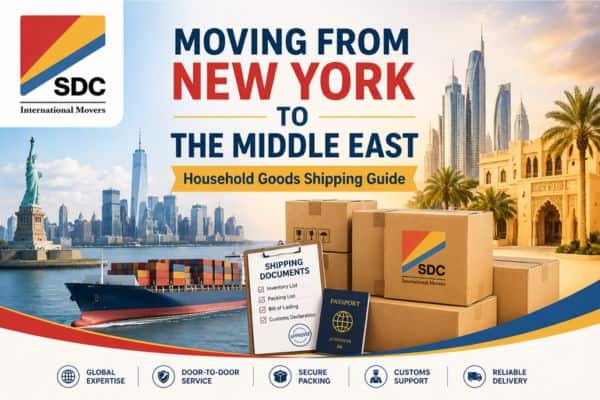
From New York, household goods move by sea through one of the East Coast’s major load ports, typically Port Newark or the Port of New York and New Jersey. Cargo bound for the Gulf then transits to the destination port in the country you are moving to.
For the UAE, virtually all household goods clear through the Port of Jebel Ali in Dubai, the largest commercial port in the Middle East. It is a well-organized facility with established customs procedures for personal effects shipments, and SDC has a reliable destination agent network there. Abu Dhabi arrivals also typically process through Jebel Ali before onward inland delivery to the capital. For Qatar, the Port of Hamad (also known as Doha Port) handles inbound household goods. Saudi Arabia routes by city: Jeddah handles the western region, while Ad Dammam serves the Eastern Province and Riyadh via road delivery from port.
Transit Times from New York to the Gulf
Sea freight from New York to Jebel Ali typically runs 25 to 35 days depending on the service and whether your shipment is moving as a full container load (FCL) or in shared consolidation (LCL). Qatar and Saudi Arabia are generally in the same range, 25 to 35 days, with inland delivery from the destination port adding several days beyond port arrival. These are ocean transit windows, not door-to-door totals. Allow additional time at both ends for packing, documentation, and customs clearance at destination, which can add two to three weeks to the overall timeline. Your coordinator will give you a specific window once the route and container type are confirmed.
What You Need to Clear Customs in Each Country
UAE Customs
To clear household goods duty-free into the UAE, your items must be used and personally owned, and the shipment should arrive within six months of obtaining your UAE residence permit. New or recently purchased items may be assessed for duty. You will need a valid UAE residence visa (or active Emirates ID), a detailed inventory packing list, a copy of your passport, and a bill of lading. AGCC country residents may not require a UAE residence visa for clearance, but your coordinator will confirm your specific situation. Customs officers at Jebel Ali inspect shipments thoroughly, so every item on your packing list needs to match what is in the container. Inaccuracies slow clearance significantly.
Qatar Customs
Qatar requires a precise and comprehensive shipping list for all household goods arrivals. Most moves to Qatar are employment-sponsored, which means your employer provides the sponsorship documentation that informs the customs process. Qatar imposes strict import restrictions on a broad range of items beyond the standard prohibited categories, including old recorded media such as CDs, DVDs, and tapes, certain communications equipment, and some categories of printed materials. Your coordinator will review your inventory before shipping to flag anything that could cause delays or be refused at port.
Saudi Arabia Customs
Saudi Arabia uses a sponsored employment model for most expat arrivals, and customs clearance for household goods is tied to your iqama (residency permit) or your employer’s facilitation. Jeddah Islamic Port and the King Abdulaziz Port in Ad Dammam both process household goods, with delivery to Riyadh by road after clearance at Dammam. A complete and itemized inventory is required. Saudi customs is known for thorough inspections, and any prohibited or questionable items will cause delays or be refused entry. Your coordinator will prepare documentation to align with local clearance requirements.
Prohibited and Restricted Items Across the Gulf
The Gulf countries share some common prohibitions but have distinct restrictions worth understanding before you pack. Across UAE, Qatar, and Saudi Arabia, the following are consistently prohibited in household goods shipments: narcotics and controlled substances, weapons and ammunition (including replicas and imitation weapons), pornographic material, and politically subversive content. Saudi Arabia and Qatar enforce strict prohibitions on alcohol; the UAE permits alcohol within certain limits for non-Muslim residents but it must not be included in an unaccompanied household goods container.
Items that frequently cause problems include large quantities of goods that appear commercial rather than personal, gambling-related items, and certain types of media. Religious materials other than Islamic texts can be scrutinized at Saudi customs in particular. New items that could be assessed as imports rather than personal effects are another common source of delay across all three countries. SDC advises shipping only items that are used, owned, and genuinely part of your household, and listing every item clearly on the inventory rather than grouping boxes generically.
Full Container or Shared Consolidation from New York
Whether you need a full 20-foot or 40-foot container, or whether your shipment moves as part of a shared consolidation, depends on volume. A studio or one-bedroom apartment will typically move as LCL, sharing container space with other households on the same route. A two- or three-bedroom home will often justify a 20-foot FCL, and larger households move in 40-foot containers. The advantage of FCL from New York is predictability: your goods load at origin, seal, and do not get touched until destination customs. LCL is cost-effective for smaller volumes but adds one more handling point. Your coordinator will recommend the right configuration based on your inventory survey.
SDC’s professional export packing service is particularly important for moves to the Gulf, where transit distances are long and port handling can be rough on unprepared shipments. Custom crating for high-value items, proper wrapping for furniture, and box labeling that matches your inventory list are all components of a clearance-ready shipment.
Timing Your New York Departure
The Gulf region has a distinct calendar that affects how you should plan your move. Ramadan, which shifts annually on the lunar calendar, significantly slows customs processing and business activity across all three countries. Port operations continue but government office clearances, NOC processes, and employer coordination can take longer during this period. Summer months (June through August) are operationally normal on the Gulf side but can see container space tighten at busy periods. Plan your shipment date at least eight to ten weeks before you need delivery, accounting for ocean transit, destination customs, and any buffer for document delays.
From New York, container pickups and packing can be coordinated with your specific departure date. SDC handles the full origin side: home packing and crating, container loading, port documentation, and pre-alert to the destination agent so that clearance paperwork is ready when your shipment arrives.
Frequently Asked Questions
Do I need my UAE residence visa before shipping?
You do not need the visa in hand before your shipment departs New York, but it must be active before customs clearance at Jebel Ali, and the shipment should arrive within six months of visa issuance to qualify for duty-free status. Timing your container departure so it arrives shortly after your visa is processed is the standard approach SDC coordinates for clients.
Can I include alcohol in my shipment to the UAE?
Alcohol should not be included in an unaccompanied household goods container destined for the UAE. Even for non-Muslim expatriates who are legally permitted to purchase alcohol in the UAE, the importation of alcohol through a personal goods shipment is not a risk-free process and can complicate clearance. Leave it out.
What if my employer is handling the sponsorship for Qatar or Saudi Arabia?
In employer-sponsored moves, your company’s local HR or PRO (Public Relations Officer) typically facilitates the customs process on the destination side. SDC coordinates pre-alert documentation with your destination agent so that everything is in order when the shipment arrives, regardless of who handles the sponsor side. Providing your employer’s contact and the sponsorship details to your SDC coordinator early makes this coordination smooth.
How do I start?
Contact SDC for a home survey and quote specific to your New York origin and Gulf destination. Your coordinator will confirm the right container type, routing, documentation checklist, and timeline for your situation. Moves from New York to the UAE, Qatar, and Saudi Arabia are corridors SDC handles regularly, so the process is well-mapped from origin to delivery.