
Greece’s Relocation Certificate for Household Goods
Greece does not ask you to prove that your furniture is old. It asks you to prove that your life was somewhere else. That difference shapes the whole paperwork trail for a household goods move, and it starts at a Greek consulate, not at a port.
SDC is a licensed door-to-door moving company with almost 20 years of experience, and this is the sequence we walk families through when they are moving a household from the US to Greece. It applies to household goods shipments, and it draws on the Greek tax and customs authority’s own relocation guidance.
What the Relocation Certificate Is
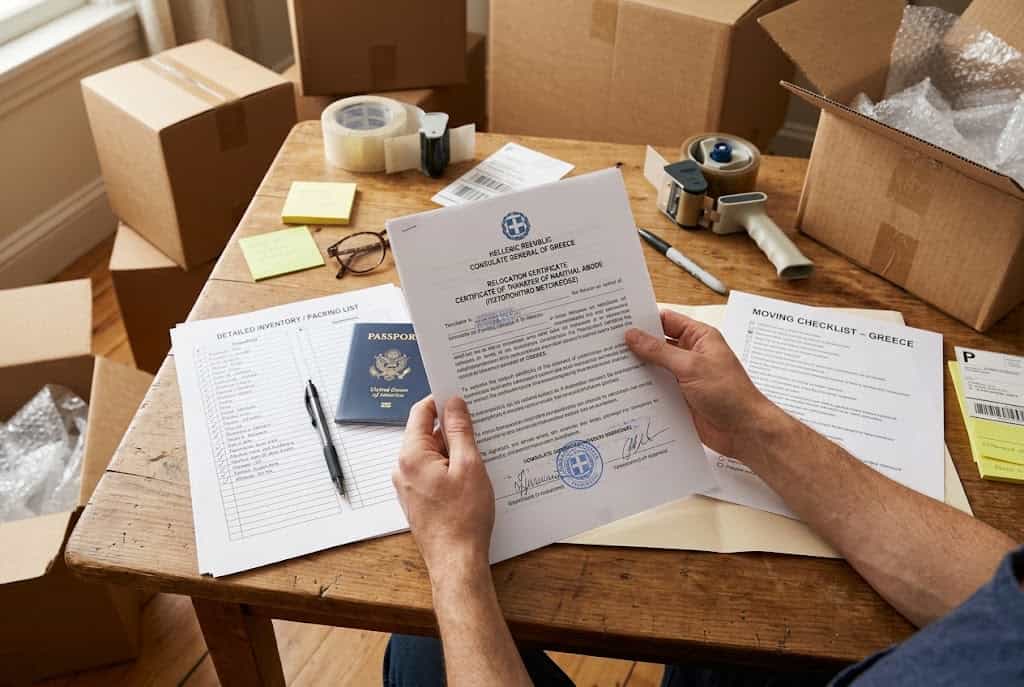
The document is the Certificate of Transfer of Habitual Abode, often called the metoikesia certificate. You apply for it at the Greek consular authority covering the country where you now live. The consulate checks your eligibility case by case, and the date it issues the certificate becomes your official transfer date.
That certificate is what unlocks the exemption. With it, your personal effects can be imported free of customs duty, VAT, and other taxes. Without it, your shipment is an ordinary import.
Who Qualifies
- Your habitual abode was abroad for the 24 months before the transfer.
- That abode meets the residence test: at least 185 days, continuous or not, in any twelve-month period, backed by personal and professional ties.
- You are not relying on study abroad. Studying somewhere does not by itself establish habitual abode there.
- If you are already in Greece, you can still apply if you declare your intention to transfer within 24 months of arrival, or 36 months if you are retiring.
Under the current rules, eligibility is assessed person by person, not for the family as a unit. A tax residence certificate alone is not enough, and neither is remote work for a foreign employer. Authorities can look at marital status, employment, children’s schooling, banking, insurance, property, and where you were physically present. Bring evidence that your life actually sat in the US.
What You Submit to the Consulate
The centerpiece is Annex I, the Detailed List of Personal Effects. Space A covers household items, Space B covers a car, and Space C covers other vehicles. The consulate reviews the list, crosses out unused blank space, and verifies your signature on the Declaration of Relocation. Supporting documents typically include residence and work permits, proof of employment, tax residence, home ownership or a lease, social security records, school records, and utility bills.
Annex I has to match what is actually in the container. Our packing crews build a carton-by-carton inventory during packing, which gives you the detail to fill in the list accurately instead of from memory.
The Twelve-Month Clock
The certificate is valid for twelve months from the day it is issued. Your personal effects have to clear Greek customs within that window, either in one go or in installments. A vehicle must clear within one month of entering Greece, and still inside the twelve months.
Clearing items after the certificate expires is one of the listed reasons Greek customs rejects an exemption. So the sequence matters. Get the certificate too early and the container still sails late, and you can burn through the window before the goods arrive. Plan the sailing first, then time the certificate to it.
What Is Exempt and What Is Not
The exemption covers customs duty, VAT, and, for cars, the registration fee and environmental fee. It does not cover alcohol or tobacco. It also excludes goods that look commercial, either by type or by quantity. Portable tools and instruments you need for your own profession are the exception. The exemption is granted once per person.
After the Container Arrives
Imported personal effects cannot be transferred, leased, pledged, or loaned for one year after customs accepts the declaration. Selling the sofa to your landlord six months in is not a harmless favor. It can put the exemption at risk.
A Realistic Order of Operations
- Confirm you meet the 24-month and 185-day tests, honestly, before you spend on anything else.
- Gather the evidence of your life in the US: tax records, lease or deed, employer letter, school records, utility bills, insurance, and banking history.
- Complete the packing survey so the inventory exists in detail.
- Apply to the Greek consular authority with Annex I and your signed declaration.
- Book the sailing so the container lands well inside the certificate’s twelve months.
- File the customs declaration digitally, with the certificate, the signed Annex I, and your supporting documents.
Greek customs publishes a helpline for questions on relocation exemptions. We recommend your coordinator confirm the current route before you file, because online platforms and phone lines change.
Questions We Hear
Do I get the certificate before I leave the US?
Yes. It comes from the Greek consular authority where you live now, so you start before the move, not after landing. Check your consulate’s current lead time before choosing a sailing date.
Does a stay as a student count?
No. Studying abroad does not by itself make the place your habitual abode.
I work remotely for a US company. Does that help or hurt?
It does not help on its own. Remote work for a foreign employer is not treated as proof that your habitual residence remains abroad, so lean on your housing, tax, schooling, and banking history.
What if my spouse and I qualify differently?
Each person is assessed on their own, so a family member who meets the conditions can qualify even if another does not.
Planning a move to Greece? Tell us your US state, when you plan to arrive, and whether a car is coming too. We will map the certificate against the sailing so the twelve months are on your side. The Greece moving guide has the wider picture, or call 877-339-0267.