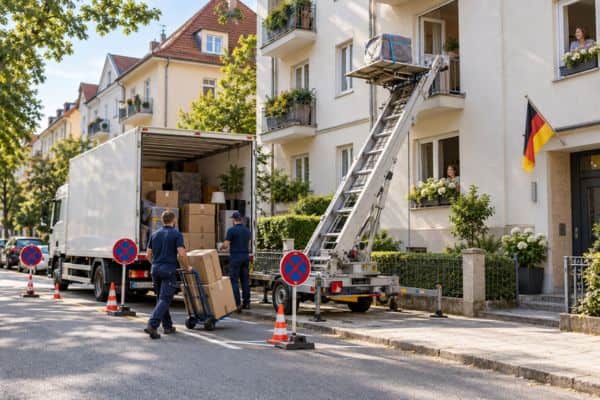

Moving Day in Germany: Parking, Lifts and Quiet Hours
Most people preparing a move to Germany worry about customs, and fair enough. But the step that catches families off guard is the street outside the new apartment. A delivery truck that has nowhere legal to stop, a fifth-floor Altbau with no elevator, a Sunday delivery that nobody is allowed to make: none of these show up on a customs form, and all of them can derail a delivery day.
SDC is an FMC-licensed door-to-door moving company, and the final leg in Germany is handled by destination partners who work within these local rules. What follows is the access checklist worth running before your pack date, for a household goods move into a German apartment or house.
Reserve the Curb Before the Truck Arrives
The Halteverbotszone
In most German cities, a moving truck needs a temporary no-parking zone, a Halteverbotszone, in front of the building. The city’s traffic authority issues the permit, and the signs have to be posted in advance. The commonly cited minimum is 72 hours before the move, because that is what makes a parked car towable. Application lead times vary by city, from a few days in smaller towns to a couple of weeks in busy districts of Berlin, Munich, or Hamburg.
Skip it and the consequences are practical, not legal. A neighbor’s car sits in the one spot the truck needs, the crew carries everything from half a block away, and the delivery runs long. Ask your destination partner at booking who applies for the permit, then confirm it is filed once your delivery date is set.
Stairs, Elevators, and the Möbellift
Older German buildings, especially pre-war Altbau, often have narrow stairwells with tight turns and no elevator. A sofa that fits through the door of the container can still fail at the second landing.
When the stairs will not work, crews use a Möbellift, an exterior furniture lift that carries items up to a window or balcony door. It needs three things from you: a window or balcony opening large enough for the item, clear street access (which is why the curb permit matters), and no tree branches or overhead lines in the way. Where it applies, expect the lift to be booked as a separate service for that day.
Measure before anything is packed. Your coordinator sizes the container from a survey, and our packing crews can crate or disassemble oversized pieces, but nobody can shrink a wardrobe that will not turn a corner. Better to learn that in the planning stage than on delivery day.
Quiet Hours and Rest Days
Germany protects its quiet time. Sundays and public holidays are rest days, and moving work, with the noise it brings, is generally not allowed on them. Weeknight quiet hours, the Ruhezeiten, usually run from about 10 p.m. to 6 a.m., and many buildings add midday restrictions in their house rules, the Hausordnung.
Plan delivery for a weekday or a Saturday daytime window. If your arrival date lands on a Sunday or a holiday, expect delivery to move to the next working day, and keep a few essentials in your luggage.
Ask Your Landlord While You Are Already Asking
If you are renting, you will already be in touch with your landlord for the Wohnungsgeberbestätigung, the confirmation letter you need to register your address. Use the same conversation to ask the access questions. Landlords and property managers know the answers, and a short message now saves a phone call from a delivery crew later.
What to Find Out and Send Your Coordinator
- Elevator interior dimensions, or the number of floors and stairwell width if there is none
- Door widths, plus window or balcony opening sizes on upper floors
- Distance from the curb to the entrance, and whether the street allows a truck to stop
- Any house rules on delivery hours, stairwell protection, or advance notice to the building manager
- Whether the address sits in a courtyard or behind a gate that limits vehicle height
Do this once the lease is signed and before the survey, so the load plan reflects the building and not just the inventory. For the broader picture of the move, the Germany moving guide covers the rest of the process.
Check What Is Waiting Inside, Too
Access is not only about getting in. Many German rentals come without a fitted kitchen, and some without light fixtures, so the first week often involves a trip to the hardware store. That changes the shipping list. Large American appliances are poor candidates anyway, since Germany runs on 230 volts and 50 Hz, and the kitchen you were planning to fill may need to be bought locally. Ask the landlord what the apartment includes before you decide what goes in the container.
Questions About Moving Day in Germany
Do I need a permit for the truck?
In most city streets, yes. A no-parking zone is the usual way to keep space for the truck. Your partner can tell you whether your street needs one.
Can I take delivery on a Saturday?
Usually, in daytime hours. Check your Hausordnung first, because some buildings set their own limits. Sunday is the day to avoid.
What if my furniture will not fit through the building?
Disassembly handles most beds and wardrobes, and a Möbellift handles heavy pieces on upper floors. For something that fits neither, selling it before the move and buying locally is often the cheaper decision.
Do these rules apply in small towns and houses?
Less so. A detached house with a driveway rarely needs a lift or a curb permit, though quiet hours and Sunday rest apply everywhere in Germany.
Have a German address in hand? Send your coordinator the building details from the list above along with your Germany destination city. We will tell you what access questions your delivery is likely to raise. Call 877-339-0267 or request a quote.