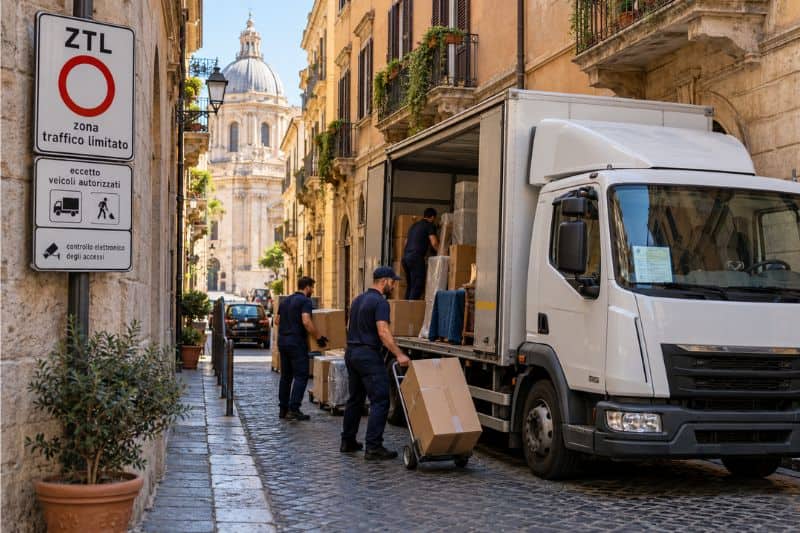

Moving Day in Italy: Permits, ZTL Zones, and Truck Access
Your container can clear Italian customs perfectly and still fail on the last 100 meters. A historic-center street, a restricted traffic zone, or a building with rules about its elevator can stop delivery day cold. In Italy, the street outside your door is often the hardest part of the move.
As an overseas moving company with almost 20 years of experience, we plan delivery access before the container sails. Here is what Rome, Milan, and Florence actually require, and where the rules are local enough that nobody should guess.
The Truck Needs a Permit for the Street
In all three cities, a moving truck that occupies public space beyond brief loading and unloading needs a temporary public land occupation permit, known as occupazione suolo pubblico (OSP). It is a municipal concession, and the city charges the Canone Unico fee for it. Each comune runs its own process.
Milan
Milan treats removals as a temporary occupation, up to 14 days and extendable, and the permit covers truck maneuvering space as well. You apply through a downloadable form to the Ufficio Permessi of the local police unit for your zone. Plan on about 15 days of notice, plus temporary no-parking signs, which are typically posted around 72 hours ahead.
Rome
Rome handles temporary concessions through the competent Municipio. The application asks for the area drawings or photos, proof of your right to the property, and the vehicle registration if an exterior lift or truck is involved. Processing is generally up to about 30 days, and longer if a restricted area needs extra approvals.
Florence
Florence runs temporary occupations for moving trucks through its online Geoworks platform, which requires Italian digital authentication (SPID, CNS, or CIE). A newcomer may not have those yet, so the removal company or the building administrator commonly files. Standard processing for longer occupations can reach 60 days, with shorter windows for same-day jobs.
Because notice runs from about two weeks to two months, confirm the timing with your coordinator as soon as you have a delivery address. Do not wait for the ship.
Restricted Zones and Heavy Trucks
Historic centers are protected by ZTLs, limited traffic zones, and goods vehicles face tighter rules than cars. Rome’s goods-vehicle ZTL covers the Centro Storico and Trastevere, with weight classes and time windows that restrict heavier vehicles in the daytime. In Florence, vehicles over 35 quintals, about 3.5 tonnes, need a separate procedure and are generally limited to early-morning hours, commonly cited as 06:00 to 08:30. In Milan, Area C in the center has its own access rules and a daily ticket, and the permit process links to those rules.
The takeaway is simple. If your address is inside an active ZTL, the truck needs the right authorization for that address and that date, in addition to the street permit.
Why Container Size Matters
Italian law sets national maximums for vehicle width, height, length, and weight, and local ordinances tighten them further in old city centers. A truck carrying a 20-foot container, about 6 meters long, is far easier to place on a narrow street than one carrying a 40-foot container. Large container vehicles often cannot reach apartment buildings inside a ZTL, which can mean smaller shuttle vehicles or staging outside the zone. There is no single national table of street limits, so we check the specific address rather than trust a rule of thumb.
Upper Floors and Exterior Lifts
An exterior hoist lift, an autoscala, is treated as a temporary occupation of public land and generally goes through the same permit. Rome’s application explicitly asks for the vehicle registration when a lift or truck is used. Florence may add a separate traffic ordinance if parking or circulation is affected. If your apartment is on a high floor or the staircase is tight, raise it early, because a lift adds a second thing to schedule.
Your Building’s Rules
Italian law treats elevators as common property. Under the Civil Code, an owner may use them as long as that does not stop others from using them equally. Case law generally allows occasional use for moving furniture unless the condominium rules, the regolamento condominiale, prohibit or limit it. A regolamento can set moving hours, require notice to the building administrator, and ask for floor protection or a deposit. No national statute sets a standard moving-day window, so the building’s own document controls. Ask your landlord or administrator for it before you set a delivery date.
What It Costs
The temporary occupation fee, the Canone Unico, depends on the area occupied, the number of days, the zone, and the type of activity, and administrative stamps are usually added. Milan publishes an online calculator. We will not quote you a fixed figure, because it varies by street and city, so ask for a written estimate once the address is known.
Questions We Hear
Who files the street permit?
The owner, tenant, or removal company with delegation may apply, depending on the city. Ask your coordinator who is filing in your case.
What if my delivery date moves?
Permits are issued for set dates, so a shipping delay can mean refiling. Build slack into your plan and read our guide on when to ship household goods before moving to Italy.
Does this apply outside the big cities?
Yes, in principle, but the process and notice vary by comune. A small town may need only a call to the local police, and a ZTL may be smaller or absent.
Moving to Italy? Send us your delivery address, your floor, and your target arrival date, and we will check access before the container is booked. Or call 877-339-0267.