What Happens at Customs When You Ship Household Goods
Why Customs Is the Most Misunderstood Part of Moving Overseas
When most families plan an overseas relocation, they focus on packing, flights, housing, and visas. Customs clearance rarely comes to mind.
Yet customs is the single most critical stage of your international move.
It is the moment your shipment legally enters your new country. It determines whether your belongings are released smoothly, inspected, taxed, delayed, or even refused entry. And it is the stage where the difference between a freight broker and a true door-to-door relocation partner becomes very clear.
If you are comparing international movers and want a clear door-to-door process, start with our overview of how an international moving company manages relocation from pickup through final delivery:
https://www.sdcinternationalshipping.com/international-movers/
Customs Is Not Just a Stamp
Many people imagine customs as a simple checkpoint, a document review and a release. In reality, customs authorities are evaluating whether you qualify for duty-free entry under transfer of residence rules.
When you ship household goods internationally, officials typically review your residency history, how long you owned and used your items, whether the shipment is strictly for personal use, and whether any restricted or taxable goods are included.
If you meet the destination country’s requirements, your used household goods can often enter duty free. If you do not, duties and VAT may apply.
Each country defines these rules differently. That is why early planning matters.
Why Household Goods Are Treated Differently Than Commercial Cargo
Your shipment is not just freight. It is tied to your immigration status and residency classification.
Most countries offer some version of duty-free entry if you are relocating your primary residence. However, that relief usually requires that you lived outside the destination country for a required period, owned and used the goods for several months prior to shipping, and intend to keep them for personal use after arrival.
The United Kingdom uses a formal Transfer of Residence system. France requires a Change of Residence Certificate. Germany applies strict 12-month residency standards. China requires import permits and often inspection depending on visa category.
These are not small technicalities. They directly affect whether your shipment clears smoothly or sits at port accumulating storage charges.
Where Most Delays Actually Happen
Damage is rarely the biggest risk in an international move. Documentation errors are.
Customs delays usually happen because inventories are vague, residency timelines do not qualify for relief, restricted items were included without declaration, or paperwork was submitted after the shipment arrived.
This is why professional inventory preparation matters. Our international packing services are designed to meet destination customs standards, not just protect furniture:
https://www.sdcinternationalshipping.com/packing-service/
Clear documentation is also central to avoiding unnecessary inspections. You can see how the broader customs process works here:
https://www.sdcinternationalshipping.com/international-customs-regulations-the-complete-guide/
Customs Is Where Experience Protects You
At SDC International Shipping, customs preparation begins before your belongings leave your home.
Your relocation specialist reviews your residency timeline, confirms required documents, and coordinates with licensed destination agents before the shipment departs. If additional forms are required, such as transfer of residence applications or non-resale declarations, those are handled proactively.
Because the truth is simple.
Customs is not the stressful part of moving overseas. Unprepared customs clearance is.
When managed by experienced international household movers, it becomes a controlled and predictable step in your relocation journey.
The Customs Clearance Process, Step by Step
One of the biggest fears clients have is not knowing what happens between “your shipment left the U.S.” and “your goods are delivered to your new home.”
Customs clearance is not a single event. It is a sequence of coordinated steps involving carriers, port terminals, licensed customs brokers, and destination agents.
When managed properly, the process is structured and predictable. Here is what actually happens.
Before Your Shipment Leaves the United States
Customs preparation does not begin at the destination port. It begins during packing.
This is why working with experienced international household movers matters. A proper export inventory is created during packing, listing contents carton by carton, not simply “miscellaneous items.” Serial numbers for electronics are recorded. High-value items are declared appropriately.
At this stage, your relocation specialist also verifies:
- Residency qualifications
- Required destination documents
- Whether transfer of residence applications must be filed in advance
- Whether restricted items should be removed
If moving to the UK, for example, the Transfer of Residence application should ideally be submitted before the shipment departs. In France, the Change of Residence Certificate must be prepared early. In Germany, residency registration documents are required. In China, import permits often cannot be issued until after arrival and residency approval.
This proactive documentation review prevents one of the most common causes of customs delays — shipping first and applying later.
Arrival at the Destination Port or Airport
Once your shipment arrives overseas, it does not immediately go to your home.
It is unloaded at the port or airport terminal and registered in the customs system under your name as consignee. At this stage:
The bill of lading or air waybill is filed
Arrival notices are issued
Terminal handling fees are assessed
The destination agent begins clearance procedures
Your destination agent submits the required documents to customs authorities. These may include passport copies, visa documentation, inventory lists, transfer of residence certificates, proof of residency, and signed declarations.
This stage is administrative but critical. Any missing or inconsistent document can pause clearance.
Customs Review and Possible Inspection
After submission, customs reviews your file.
In many cases, shipments clear based solely on documentation. However, customs authorities reserve the right to inspect any shipment physically.
An inspection may involve:
Opening selected cartons
Verifying declared items
Checking for restricted goods
Confirming ownership of high-value items
Inspections are random in some countries and risk-based in others. For example, vague inventories, new items less than six months old, or undeclared alcohol increase the likelihood of inspection.
This is another reason professional packing and documentation matter. Our packing services are structured around compliance, not just protection:
https://www.sdcinternationalshipping.com/packing-service/
If duties or taxes are assessed, they must be paid before release. Your destination agent will provide the official customs calculation for review.
Customs Release and Final Delivery
Once customs clearance is granted, the shipment is officially released.
At this point:
Terminal release is issued
Port handling charges are finalized
Delivery is scheduled
Unloading and placement are completed at your residence
If you selected full door-to-door service, unpacking and debris removal can also be arranged.
From your perspective, delivery feels like the final step. From a compliance standpoint, customs clearance was the most important milestone in the journey.
Why Door-to-Door Management Changes Everything
When you hire a freight-only provider, you may be responsible for coordinating customs clearance independently.
When you hire a full-service international moving company, customs is built into the relocation strategy from the beginning.
You can see how our complete international moving process works here:
https://www.sdcinternationalshipping.com/international-movers/
The difference is not just convenience. It is risk reduction.
Customs clearance is where international relocations succeed or stall. With proper documentation, destination coordination, and proactive planning, it becomes a structured step rather than a stressful unknown.
Documents You’ll Almost Always Need for Customs Clearance
If there is one truth about international moving, it is this: customs clearance is paperwork-driven.
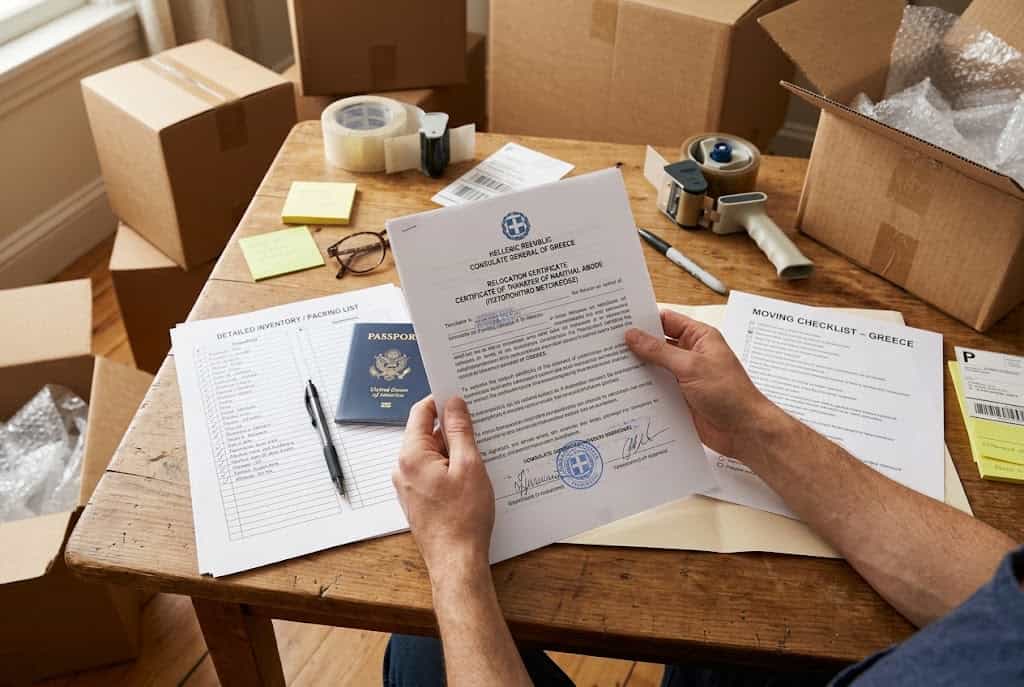
Your shipment does not clear based on how well it was packed or how long it traveled. It clears based on documentation that proves you qualify for duty-free entry and that your goods meet the destination country’s regulations.
While each country has its own requirements, there are core documents that apply to nearly every overseas relocation.
Passport and Visa Documentation
Customs authorities must confirm your legal status in the destination country.
A copy of your passport is always required. In most cases, visa documentation or residency permits must also be submitted. Some countries require proof that you will reside there for a minimum period, often twelve months.
For example, the United Kingdom requires a Transfer of Residence application to qualify for relief from duties. Germany requires proof that you lived outside the EU for at least twelve months and that you are registering your new residence. France requires formal documentation confirming your relocation is permanent.
If residency documentation is incomplete, customs may treat the shipment as a standard commercial import, which can trigger duties and VAT.
This is why customs preparation must begin before your shipment departs.
Detailed Inventory and Valued Packing List
The inventory is one of the most important documents in your file.
It must clearly describe the contents of each carton and identify high-value items separately. Vague descriptions such as “miscellaneous household goods” increase the risk of inspection.
In some destinations, values must be declared in local currency. In others, serial numbers for electronics are required. New items less than six months old may be taxed.
Our international packing services are structured around customs compliance as much as physical protection:
https://www.sdcinternationalshipping.com/packing-service/
A properly prepared inventory reduces inspection risk and speeds clearance.
Proof of Residency in the Destination Country
Most countries require proof that you are establishing residence.
This may include:
A lease agreement
A property purchase contract
Utility bills
Municipal registration confirmation
Without proof of residency, duty-free entry may be denied.
In Germany, for example, official registration with the local town hall is required. In the UK, documentation supporting your Transfer of Residence application must demonstrate that you are moving your primary home.
Customs officials are verifying that you are relocating, not temporarily importing goods.
Transfer of Residence or Change of Residence Certificates
Many countries operate under a formal “transfer of residence” framework.
The United Kingdom uses an online Transfer of Residence system that must be approved before clearance. France requires a Change of Residence Certificate issued by the French consulate or proof of work assignment. Germany requires documentation proving more than twelve months of residency outside the EU before returning.
These programs are designed to allow used household goods to enter duty free, provided the qualifying criteria are met.
You can learn more about how customs clearance works in detail here:
https://www.sdcinternationalshipping.com/international-customs-regulations-the-complete-guide/
Failing to apply for these relief programs in advance is one of the most common causes of delays and unexpected taxes.
Non-Resale Declarations and Special Forms
Many countries require you to sign a declaration stating that your imported household goods will not be sold for a defined period, typically twelve months.
This declaration confirms that you are importing for personal use, not commercial resale.
Additional documents may be required if you are shipping:
A vehicle
Artwork or high-value collectibles
Professional equipment
Alcohol or tobacco
If vehicles are included in your container shipment, customs rules become even more specific. We strongly recommend containerized vehicle shipping with household goods rather than roll-on roll-off options, as this simplifies documentation and protects the vehicle during transit.
Why Document Preparation Is Strategic, Not Administrative
Most customs problems do not happen because someone tried to break the rules. They happen because the rules were misunderstood.
At SDC International Shipping, document review is part of your relocation strategy. Your coordinator works with licensed destination agents to confirm exactly what is required before departure.
Because once your shipment is at port, paperwork errors become expensive.
What Gets Flagged by Customs, and Why
By the time your shipment reaches customs, your documentation has already been reviewed. But paperwork alone does not determine whether your shipment moves straight through or gets pulled for inspection.
Customs authorities use risk indicators. Certain items, descriptions, and patterns increase the likelihood of inspection or taxation.
Understanding these in advance prevents surprises.
Alcohol and Tobacco
Almost every country taxes alcohol and tobacco, even if the rest of your shipment qualifies for duty-free entry.
Many clients assume that a few bottles of wine packed in the kitchen cartons will not matter. In reality, alcohol must typically be declared separately, including quantity, size, and alcohol percentage.
Some countries allow limited importation with duties. Others restrict alcohol entirely in household goods shipments. In certain destinations, alcohol automatically triggers inspection.
If alcohol or tobacco is included without declaration, customs may impose fines, seize the items, or order a full inspection of the shipment.
This is why we advise clients early in the process about destination-specific restrictions before packing day.
New Items Less Than Six Months Old
Duty-free entry programs are designed for used personal effects.
If you recently purchased new furniture, electronics, or appliances and they are less than six months old, customs may assess duties and VAT based on declared value.
This is especially common when:
Items are still in original packaging
Receipts are included in cartons
High-value electronics appear unused
Declaring new items properly does not prevent clearance. It simply allows customs to assess duties accurately. Attempting to conceal new items, however, increases inspection risk.
Transparency always reduces delays.
Food, Plants, and Organic Materials
Food is one of the most common causes of customs issues.
Even sealed, non-perishable goods can trigger inspection depending on the country. Fresh food, meat products, seeds, and plant materials are often prohibited.
Including food items in your shipment can cause:
Port health inspections
Quarantine holds
Additional handling fees
Destruction of the items
Many clients are surprised that even dry pantry goods may be restricted. When in doubt, it is usually safer to purchase food after arrival.
Electronics and High-Value Items
Electronics are not prohibited, but they are often reviewed carefully.
Customs may verify:
Serial numbers
Declared values
Ownership duration
Compatibility with local electrical standards
Large quantities of identical electronics may appear commercial rather than personal. High-value artwork, antiques, or collectibles may require additional documentation.
If you are shipping artwork or valuables, it is important to prepare them properly and declare them accurately. Our specialized artwork shipping services are structured to handle these compliance requirements:
https://www.sdcinternationalshipping.com/overseas-artwork-shipping/
Proper crating and valuation reduce inspection complications.
Vehicles and Special Equipment
Shipping a vehicle with your household goods introduces additional regulations.
Most countries require proof of ownership, proof of prior use, and evidence that you lived abroad for a required period. Some countries impose environmental compliance standards before registration.
We strongly recommend containerized vehicle shipping alongside household goods rather than roll-on roll-off methods. Containerization provides better protection and simplifies documentation management under one bill of lading.
You can learn more about containerized vehicle shipping here:
https://www.sdcinternationalshipping.com/international-shipping-containers/
Vehicle documentation errors are one of the most expensive customs mistakes. Proper preparation prevents that.
Vague Inventories and “Packed by Owner” Shipments
One of the biggest inspection triggers is a poorly written inventory.
Descriptions like “miscellaneous,” “personal items,” or “PBO” (packed by owner) signal risk to customs officials. They cannot verify contents easily, so inspection becomes more likely.
Professional packing creates detailed inventories that satisfy customs requirements and reduce unnecessary physical examinations.
This is not about over-documenting. It is about removing doubt from the file.
Customs Flags Patterns, Not People
It is important to understand that customs inspections are not personal. They are procedural.
Officers look for inconsistencies, undeclared restricted items, and signs that the shipment may not qualify for duty-free entry. When documentation is clean and items are declared properly, clearance is typically straightforward.
The goal is not to avoid customs review. The goal is to eliminate uncertainty before your shipment arrives.
How Customs Requirements Differ by Country, and Why Planning Matters
Customs clearance is not universal. The rules change depending on where you are moving.
This is where many international relocations run into trouble. Clients assume that “household goods are household goods.” In reality, each country defines duty-free eligibility differently.
Understanding these differences before shipping is what separates a smooth relocation from an expensive delay.
Moving to the United Kingdom
The UK operates under a formal Transfer of Residence system.
You must apply online for approval before your shipment clears. If approved, you receive authorization that allows your used household goods to enter duty free, provided you lived outside the UK for the required period and owned your items long enough.
Failure to apply in advance can delay clearance. Alcohol, tobacco, and newly purchased goods are taxed separately.
This system is structured but strict. Documentation sequencing matters.
Moving to France
France requires a Change of Residence Certificate or proof of work assignment confirming that you are permanently relocating.
The documentation must clearly state how long you lived abroad and when you are establishing residence in France. Without it, duties and VAT may be assessed on the full declared value of your shipment.
France also requires valued inventories in Euros and signed non-resale declarations.
Paperwork precision is critical.
Moving to Germany
Germany applies a twelve-month residency rule.
To qualify for duty-free entry, you must demonstrate that you lived outside the EU for at least twelve months and that your household goods were owned and used for at least six months before shipping.
You must also register your new residence in Germany after arrival.
German customs authorities are structured and documentation-driven. Incomplete registration paperwork can delay release.
Moving to China
China’s process is more permit-driven and inspection-based.
Foreign nationals typically require an import permit tied to their residence and work authorization. Returning citizens face additional documentation requirements, including stamped baggage declaration forms.
Food, alcohol, electronics, and printed media are frequently inspected. Some items are prohibited entirely.
China customs enforcement varies by city, which makes coordination with experienced destination agents essential.
Why Delays Happen, and How to Prevent Them
Across all destinations, customs delays usually happen for predictable reasons.
Shipments are dispatched before residency approval is complete. Inventories are vague or inconsistent. Restricted items are included without declaration. Transfer of residence applications are filed too late.
When that happens, shipments sit at port. Storage charges accumulate. Inspections are ordered.
The good news is that nearly all of these delays are preventable.
Planning documentation before departure eliminates most customs risk.
Why an Experienced International Moving Company Changes the Outcome
Customs clearance is not a last-minute administrative step. It is a strategy.
At SDC International Shipping, documentation review, inventory preparation, and destination coordination begin before packing day. Your relocation specialist confirms eligibility requirements and works directly with licensed destination agents to ensure that clearance procedures are prepared in advance.
This is what separates freight forwarding from full-service relocation.
You can see how our complete international moving process works here:
https://www.sdcinternationalshipping.com/international-movers/
When you work with experienced international movers, customs becomes predictable rather than stressful.
Because in international relocation, the goal is not simply to ship boxes.
The goal is to transfer your life across borders without unnecessary delays, inspections, or surprise taxes.