

Can I Ship My Piano from the USA to Italy? Crating, Customs, and What to Expect
Yes, you can ship your piano from the USA to Italy, and for most households relocating permanently, it is worth doing. Pianos represent a significant financial and personal investment; Italian movers are experienced with them, and the cost of shipping a well-packed instrument is generally less than replacing it with a comparable instrument in Italy. What the process requires is proper crating, the right customs documentation, and in some cases a professional appraisal if the instrument is of high value.
This guide covers everything an American moving to Italy needs to know about shipping a piano: crating requirements, Italian customs rules under the EU Transfer of Residence framework, the codice fiscale timing issue, and what SDC coordinates on your behalf. For a door-to-door shipping quote that includes your piano, SDC International Shipping handles household goods moves to Italy from all 50 US states.
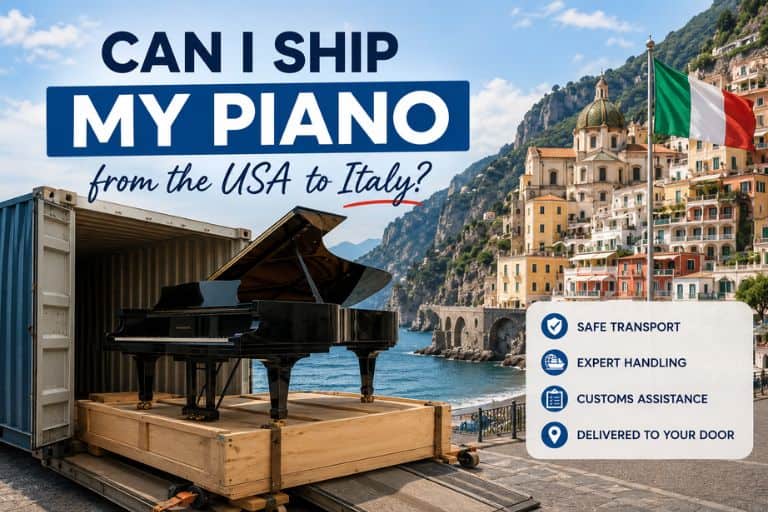
Piano Shipping to Italy: Quick Facts
Can I ship my piano to Italy: Yes
Crating: Custom wood crate required for ocean freight, ISPM-15 certified
Customs Relief: EU Transfer of Residence (dichiarazione di trasferimento di residenza)
Customs Authority: Agenzia delle Dogane e dei Monopoli
Prior Residence Outside EU: Minimum 12 consecutive months
Item Ownership Requirement: Owned and used for at least 6 months before shipment
High-Value Instruments: Professional appraisal may be requested by Italian customs
Key Timing Requirement: Codice fiscale must be in hand before customs clearance can complete
Destination Ports: Genoa (primary), La Spezia, Naples
Ocean Transit from East Coast USA: 12 to 16 days
Total Door-to-Door: 8 to 12 weeks
Crating Requirements for Ocean Freight
A piano shipped in a standard moving carton or household blanket wrap is not adequately protected for ocean freight. A transatlantic container crossing can take 12 to 16 days from East Coast ports, during which the container experiences humidity changes, vibration, and temperature variation that can damage an instrument that is not properly enclosed.
Custom wood crating
The correct method for shipping a piano internationally is a custom-built wood crate, constructed to the specific dimensions of your instrument. The crate provides rigid structural protection against impact and prevents the piano from shifting during transit. SDC builds custom crates for pianos and other high-value instruments as part of the export packing process. The crate is built around your piano at your US home before loading into the container.
ISPM-15 certification
Italy, as an EU member state, requires that all wood packaging materials used in international shipments comply with ISPM-15 (International Standards for Phytosanitary Measures No. 15). This means the wood used in your piano crate must be heat-treated or fumigated to prevent the transport of wood-borne pests, and must carry the official ISPM-15 mark. SDC uses ISPM-15 compliant materials for all custom crating, and your crate will be marked accordingly. A shipment arriving at Genoa or La Spezia with non-compliant wood packaging will be held for phytosanitary treatment, which adds time and cost. This is not a risk SDC takes.
Upright versus grand piano
Upright pianos are more straightforward to crate and load than grand pianos. A grand piano requires disassembly before crating: the legs, lyre, and lid are removed, the harp is protected, and the key components are individually wrapped before being enclosed in the crate. The reassembly and tuning at the Italian destination is handled by a local piano technician, which SDC’s destination partner can coordinate. Allow for a tuning appointment two to four weeks after delivery once the instrument has acclimated to its new environment.
Italian Customs: What Applies to Your Piano
A piano shipped as part of a household goods move to Italy is treated as a personal effect under the EU Transfer of Residence framework, known in Italy as the dichiarazione di trasferimento di residenza. This means it can be imported duty-free alongside the rest of your household goods, provided you meet the eligibility requirements.
Eligibility requirements
To import your piano duty-free under the Transfer of Residence framework, you must have lived outside the EU for at least 12 consecutive months before your move to Italy, the piano must have been owned and used by you for at least six months before the container ships, and you must retain the instrument for your own personal use in Italy for at least 12 months after importation. A piano purchased within six months of your shipping date does not qualify for duty-free status and will be assessed Italian customs duties and VAT. If you are planning to buy an instrument specifically for the move, do so well in advance of your packing date.
Appraisal for high-value instruments
Italian customs, administered by the Agenzia delle Dogane e dei Monopoli, sometimes requests a professional appraisal for high-value instruments declared in a household goods shipment. This is selective and not a routine requirement for every piano, but it is more likely when the declared value on the inventory is high or when the instrument is a recognized professional or antique model. If you own a Steinway concert grand, a vintage Bösendorfer, or another instrument with a replacement value in the tens of thousands of dollars, having a current professional appraisal ready before your container ships is a practical precaution. Your SDC coordinator will advise based on your specific instrument and declared value.
The codice fiscale requirement
The codice fiscale is the Italian tax identification number required to complete customs clearance for any household goods shipment entering Italy. Without it, your shipment, including your piano, cannot be released from Italian customs. The codice fiscale is not difficult to obtain but requires planning: Americans can apply for it at the Italian consulate in their home US state before departure. Processing typically runs a few days to two weeks depending on the consulate.
SDC strongly recommends obtaining your codice fiscale before your container ships. Your piano can cross the Atlantic and arrive at the Port of Genoa, but Italian customs will not release the shipment until the codice fiscale is on file. Obtaining it in the US before departure eliminates this risk entirely. Your SDC coordinator includes the codice fiscale in the pre-departure document checklist and confirms it is in hand before finalizing the customs file.
Container Planning with a Piano
A crated upright piano typically measures roughly 160 to 180 cm wide, 80 to 100 cm deep, and 150 to 180 cm tall, and weighs 200 to 400 kg depending on the model. A crated grand piano is larger and heavier. Both fit inside a standard 20-foot or 40-foot shipping container alongside the rest of a household shipment, though container loading requires planning for weight distribution and access.
SDC loads the piano crate first, positioning it against the container wall with weight balanced appropriately, then packs household goods around it. This is not something that can be improvised on packing day; it requires a loading plan prepared in advance. For households moving to Italy with a piano as part of the shipment, SDC’s international packing and export documentation service covers the custom crating, ISPM-15 compliance, container loading plan, and the customs inventory that lists the piano with its make, model, serial number, and declared value.
Timeline: LA or East Coast to Italy with a Piano
Adding a piano to a household goods shipment does not extend the overall timeline significantly. The crating is done on packing day. The main variable that affects timeline is the codice fiscale and the Italian customs clearance process.
From East Coast US ports to Genoa or La Spezia, ocean transit runs 12 to 16 days. Total door-to-door time including packing, export processing, ocean transit, and Italian customs clearance typically runs 8 to 12 weeks. Italian customs clearance on a complete, well-documented file typically runs 5 to 15 business days. The Nulla Osta, the Italian customs authorization issued by the Agenzia delle Dogane confirming the shipment qualifies for duty-free Transfer of Residence relief, is the final step before your goods including the piano are released for delivery. SDC’s Italian destination partner manages the Nulla Osta process on your behalf.
Frequently Asked Questions
Can I ship my piano from the USA to Italy?
Yes. A piano can be shipped as part of a household goods move to Italy in a custom wood crate inside a standard shipping container. The crate must comply with ISPM-15 wood packaging standards for EU import. Italian customs treats the piano as a personal effect under the EU Transfer of Residence framework, meaning it can be imported duty-free alongside your other household goods provided the eligibility conditions are met.
Does my piano need a special crate for ocean shipping?
Yes. A custom-built wood crate is required for ocean freight. Standard household blanket wrapping or cardboard packaging is not adequate for a transatlantic crossing. The crate must be built to your piano’s specific dimensions, and the wood must be ISPM-15 certified for EU import. SDC builds custom crates at your US home on packing day as part of the export preparation.
Will Italian customs charge duty on my piano?
Not if you qualify for EU Transfer of Residence relief. If you have lived outside the EU for at least 12 consecutive months and have owned and used the piano for at least six months before your container ships, it can be imported duty-free as part of your household goods. If the instrument was purchased within six months of the shipping date, it will be assessed Italian customs duties and VAT. For high-value instruments, Italian customs may request a professional appraisal.
What is a Nulla Osta and does my piano need one?
The Nulla Osta is the Italian customs authorization issued by the Agenzia delle Dogane e dei Monopoli confirming that your household goods shipment, including your piano, qualifies for duty-free Transfer of Residence relief and can be released. It applies to the entire shipment, not just the piano individually. SDC’s Italian destination partner handles the Nulla Osta process as part of the customs clearance service.
Do I need a codice fiscale to import my piano?
Yes. The codice fiscale is required to complete customs clearance for any household goods shipment entering Italy, including one that contains a piano. Without it, the shipment cannot be released. SDC strongly recommends obtaining your codice fiscale at the Italian consulate in the US before your container ships. It can also be obtained after arrival in Italy, but having it in advance removes a potential clearance delay.
How long does it take to ship a piano from the USA to Italy?
Total door-to-door time from the US to Italy with a piano included in the shipment typically runs 8 to 12 weeks from East Coast origins. Ocean transit from East Coast ports to Genoa or La Spezia runs 12 to 16 days. The remainder covers packing and export at the US end, and Italian customs clearance and delivery at the Italian end. After delivery, allow two to four weeks before scheduling a tuning appointment so the instrument can acclimate to its new environment.
Can I ship a grand piano to Italy?
Yes. Grand pianos require disassembly before crating: legs, lyre, and lid are removed and individually protected before the main body is enclosed in the custom crate. Reassembly and tuning at the Italian destination is coordinated by SDC’s destination partner with a local piano technician. The customs and crating process is the same as for an upright piano.