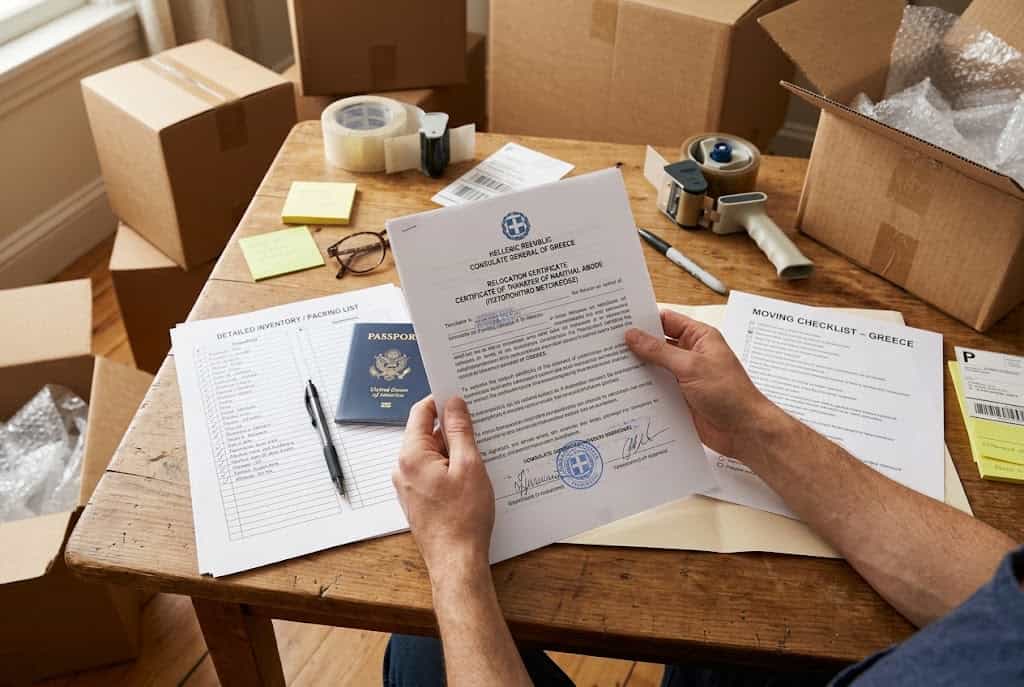
Sweden Duty Relief for Household Goods: Form Tv 740.45
Swedish Customs makes the final call at the border. Not the form, and not the moving company: the officer who clears the shipment decides whether your belongings enter duty-free. Your job is to show up with paperwork that leaves nothing to decide.
SDC is a FMC-licensed door-to-door moving company, and this article covers the duty relief for household goods that Americans claim when they move to Sweden, based on Swedish Customs’ published form and guidance.
The Rule in One Paragraph
Under Council Regulation (EC) No. 1186/2009, which Sweden applies, you can bring your personal belongings into Sweden without customs duty or VAT if you meet the conditions. The two conditions the declaration form tests directly: you had your normal residence in a country outside the EU for a continuous period of more than one year, and the goods have been owned and used for at least six months before the move.
What “Normal Residence” Means to Swedish Customs
It is not a day count. Swedish Customs looks at where your permanent center of life is: family, housing, finances, population records, and social benefits. A person cannot have normal residence in Sweden and outside the EU at the same time. The length of your stay outside the EU matters mainly when those other factors do not settle the question.
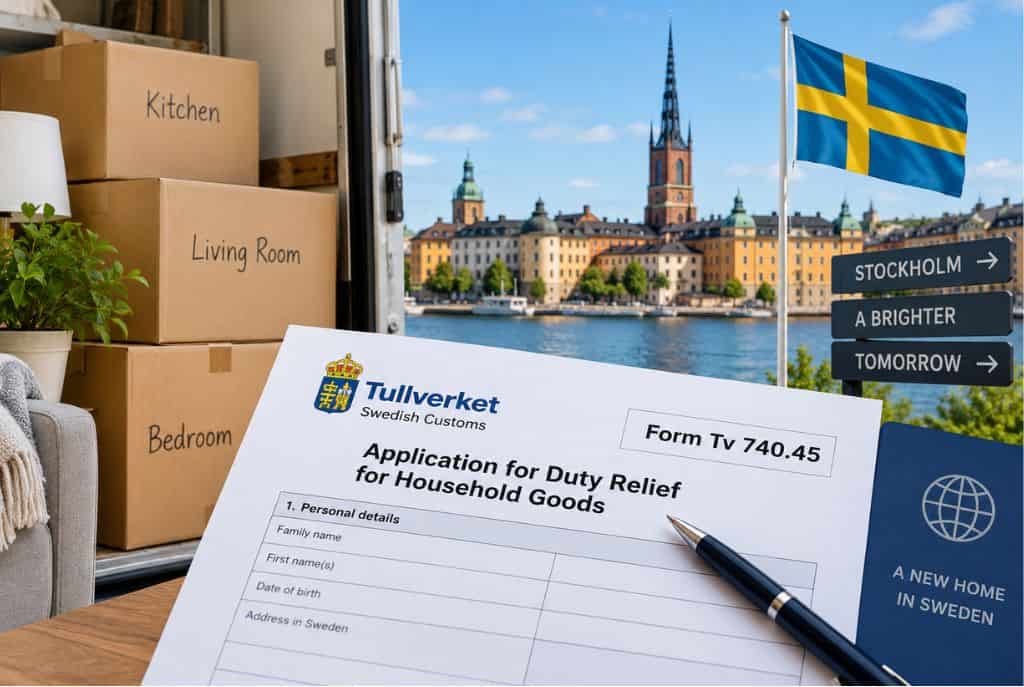
The Declaration: Tv 740.45
The form is titled “Declaration for obtaining relief from customs duty and tax on personal belongings when migrating to Sweden,” and the current edition is dated April 2026. People returning to Sweden use a different form, Tv 740.47, and there is a separate one for moving to Sweden on the occasion of marriage.
What You Attach
- A list of the goods with a description, number of items, and value
- Proof you moved to Sweden
- Proof of residence in a non-EU country, such as residence or work permits, employer certificates, or rental and sale contracts
- Proof of ownership, such as invoices, receipts, foreign insurance documents, or shipping documents
- Proof you used the goods outside the EU
The goods list is the part we help with. Our packing crews describe every carton at origin, so the list you attach matches what is in the container.
What Is Not Covered
The form asks whether the shipment includes alcohol, tobacco, or other products with special entry rules. Examples Swedish Customs gives include medicines, animals, plants, certain fruits and foods, and weapons and ammunition, all of which need permission or specific conditions. Alcohol and tobacco for private use are personal property, but they do not enter duty-free.
The One-Year Rule After Import
For a year after you lodge the declaration, you must report to Swedish Customs if you lend, hire out, transfer, or pledge the relief goods, and you must pay full duty and taxes on them first. The same rule applies to vehicles. It is a real restriction, not a formality.
Be Accurate on the Form
You sign a statement that the information is correct and truthful. Incorrect or incomplete information can create liability under the Swedish Act (2000:1225) on Penalties for Smuggling. If you are unsure whether something belongs on the list, ask your coordinator before you sign.
Build Your Evidence File Early
Customs decides on documents, so assemble them before the movers arrive. Keep in one folder: your lease or sale contract, employer certificate, residence or work permit, and anything that shows your life in the US was real, such as utility bills and bank statements. For the goods themselves, hold on to receipts, warranty cards, insurance schedules, and shipping documents, since those are the ownership proof Swedish Customs names. Group anything bought within six months of departure on a separate page, so you can show clearly what qualifies and what does not.
A Car on the Same Declaration
Vehicles have their own section on the form. Expect to give the vehicle details, purchase and registration information, and proof of third-party insurance. SDC ships cars only when they are containerized with household goods, and we do not handle vehicle-only shipments. For Swedish rules on registering the car after it clears, check with the relevant Swedish authority before you ship.
Questions We Hear
Is there a deadline for filing?
The form itself does not set one, but it asks for your date of entry and the date you arrived in Sweden. Treat the first clearance as the moment to file, and keep your proof of residence handy.
Do my belongings have to be six months old?
They need to have been owned and used for at least six months before you moved. New purchases for the move are the usual problem, so keep receipts and date the items on your list.
Can I bring pets under the same relief?
Swedish Customs includes pets in personal property, but animals are on its restricted list and have their own import conditions. SDC does not ship pets, so ask us for a referral.
I lived in another EU country at some point. Does it matter?
It can. The test is where your normal residence was, and time in the EU can complicate the one-year-outside-the-EU requirement. Tell your coordinator the whole timeline early so the form describes it accurately.
Where do I send the form?
Swedish Customs (Tullverket) lists a Stockholm postal address and an email on the form. Your coordinator will confirm the current submission route before you ship.
Planning a move to Sweden? Tell us where in the US you live, your target arrival date, and whether a car is coming. We will help you sequence the proof of residence, the goods list, and the sailing. See the Sweden moving guide, or call 877-339-0267.