Singapore GST Relief on Household Goods: Do You Qualify?
Shipping household goods to Singapore comes with a real financial decision point most people don’t realize they’re facing until customs asks for it: whether your shipment qualifies for GST relief, or whether you’re paying Singapore’s 9% Goods and Services Tax on the full declared value of everything you own. As a licensed door-to-door moving company, we build shipment timing around this eligibility question from the start, because the rules are specific and unforgiving if you miss them.
What Singapore’s GST Relief Actually Covers
Singapore Customs grants GST relief on used household articles and personal effects to two groups: Singapore citizens or permanent residents who’ve been living overseas and are returning to live in Singapore, and foreign nationals relocating or migrating to Singapore. This is a different scheme from the general “GST import relief” travelers get on items carried in their luggage, which is based on trip duration and applies to a much smaller allowance. If you’re shipping a full household by sea or air freight, you’re working with the household goods relief, not the traveler’s allowance, and the eligibility conditions are stricter. One condition that’s easy to overlook: the importer has to be the actual owner of the goods being shipped. A shipment mixing in items that belong to a family member who isn’t the one relocating can complicate the relief application, so it’s worth sorting out ownership on paper before the inventory is finalized, not after customs asks about it.
The 3-Month Ownership Rule
To qualify, you need to have owned and used the items in your shipment for at least 3 months before importation. This isn’t a formality; customs can and does ask for proof, particularly on higher-value items. Newly purchased furniture or electronics bought specifically for the move, still in original packaging, don’t meet this bar and will be assessed for GST regardless of what else in the shipment qualifies.
The 6-Month Import Window
Your shipment has to arrive within 6 months of your first arrival in Singapore. This window runs from your entry date, not your visa approval date or your move-planning start date, which is a detail that trips people up when a work pass takes months to process. If your household goods are still packed in a US warehouse five months after you’ve relocated, the clock is already most of the way through, and a delayed sailing can push the shipment outside the relief window entirely.
The 3-Month No-Resale Condition
Relief comes with a forward-looking condition too: you agree not to sell, give away, or otherwise dispose of the relieved items within 3 months of their arrival in Singapore. This is a formal undertaking made as part of the relief application, not just a guideline, so it’s worth factoring in if you’re planning to downsize or sell off furniture shortly after your goods land.
Filing the Declaration of Facts
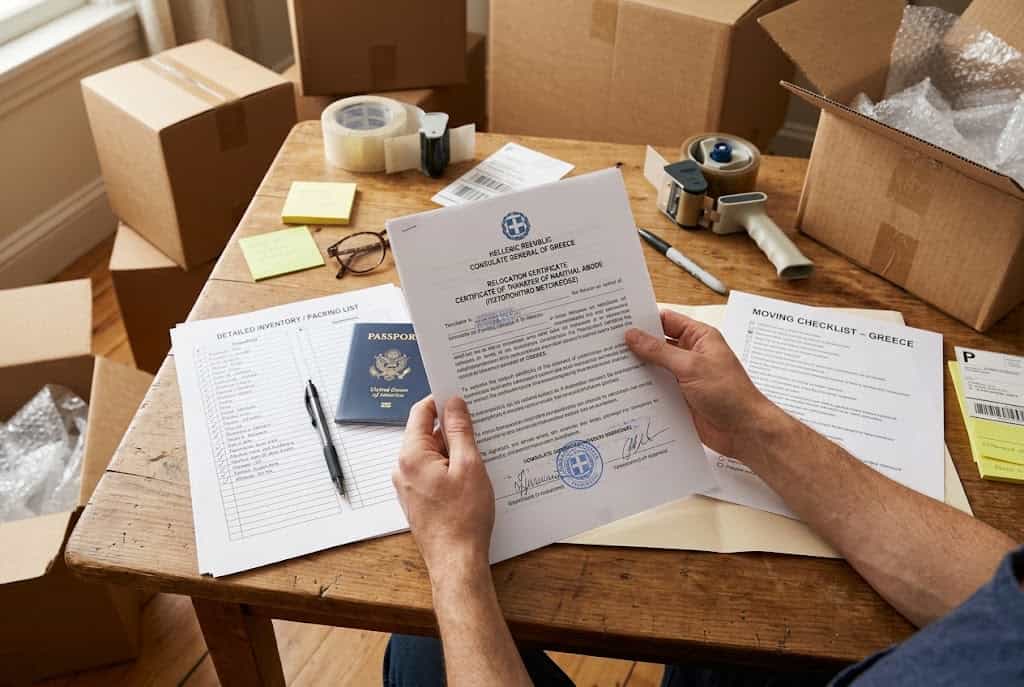
GST relief isn’t automatic on arrival. For unaccompanied shipments arriving by sea or air, the importer or their agent submits a Declaration of Facts (DOF) to Singapore Customs, along with supporting documentation confirming ownership, usage period, and the move itself. Our packing service builds a detailed, dated inventory as part of export preparation, which becomes the backbone of that supporting documentation, so the filing isn’t assembled after the fact under time pressure.
The DOF filing needs your passport or FIN details, arrival information such as your flight or entry date, and a specific, itemized list of the goods in your shipment with type and declared value for each. A blanket “household goods, various value” line doesn’t satisfy this; customs wants a real inventory, and a declared value of zero on any item isn’t accepted. Singapore Customs also conducts selective checks at checkpoints, so a shipment with a thorough, honest inventory clears faster than one that looks assembled at the last minute.
What Never Qualifies, Regardless of Timing
Some categories are excluded from relief no matter how long you’ve owned them or how far inside the windows you are. Motor vehicles, intoxicating liquors, and tobacco products always incur GST and, where applicable, duty. Vehicles specifically require separate approval from Singapore’s Land Transport Authority regardless of GST status, a process that runs independently of your household goods relief and on its own timeline. SDC ships vehicles only when containerized with household goods, never as a standalone shipment, so if a vehicle is part of your move, it needs to be identified early and handled through its own clearance process rather than folded into your household relief filing.
If You Don’t Qualify
Shipments that don’t meet the relief conditions aren’t blocked, they’re just taxed. Singapore Customs distinguishes between two permit types here: an “In-Non-Payment (GST Relief) permit” for shipments that qualify, and a “Customs In-Payment (GST) permit” for shipments that don’t, which accounts for and collects GST on the declared value, currently at 9%, before release. If any item in the shipment is dutiable on top of GST, a combined In-Payment (Duty and GST) permit applies instead. Knowing early which permit your shipment is likely to fall under changes the financial picture of the move considerably, which is why we walk through ownership dates and your expected arrival timeline before your shipment is packed, not after it’s already at the port.
Request a free quote and we’ll help you map your ownership history and arrival timeline against Singapore’s relief conditions before your shipment departs.