
Navigating Customs When Moving from Los Angeles to Japan
Updated June 2026
Shipping household goods from Los Angeles to Japan involves one of the more document-intensive customs processes in international moving. Japan’s customs authority, Japan Customs, applies strict import controls to personal effects shipments, and the requirements differ depending on whether you are relocating permanently, arriving on a work assignment, or shipping goods that follow you after you’ve already entered the country.
SDC International Shipping is an FMC-licensed international moving company based in Sherman Oaks, and we coordinate door-to-door household goods shipments from Los Angeles to Japan, managing ocean freight from the Port of Los Angeles or Long Beach through customs clearance and final delivery at your Japanese address.

How Japan Customs Handles Personal Effects Shipments
Japan permits duty-free import of used personal effects and household goods for individuals who are relocating their primary residence to Japan. The key conditions are that the goods must have been owned and used by you for at least one year prior to shipment, and the shipment must arrive within a reasonable period of your own entry into Japan.
Japan Customs draws a meaningful distinction between accompanied baggage (goods you bring with you when you enter) and unaccompanied baggage (a separate freight shipment that arrives before or after you). Household goods shipped by sea from Los Angeles fall into the unaccompanied baggage category and are processed accordingly. The duty-free personal effects exemption applies to both categories, but the documentation requirements and clearance procedures are handled differently.
Timing Your Shipment Relative to Your Arrival
Japan Customs allows unaccompanied personal effects to arrive up to six months before or after the owner’s entry into Japan and still qualify for duty-free treatment, provided the eligibility conditions are met. If your shipment arrives outside that window, it may be assessed for duties and taxes. Planning your ocean freight departure from Los Angeles with this timing in mind is one of the most important logistical decisions in a Japan move.
Ocean freight from Los Angeles to Japan typically takes 2 to 3 weeks port to port. With inland pickup, port processing at both ends, and Japanese customs clearance, the realistic door-to-door window is 4 to 8 weeks depending on routing, vessel schedule, and how quickly your paperwork clears.
Documents Required for Japan Customs Clearance
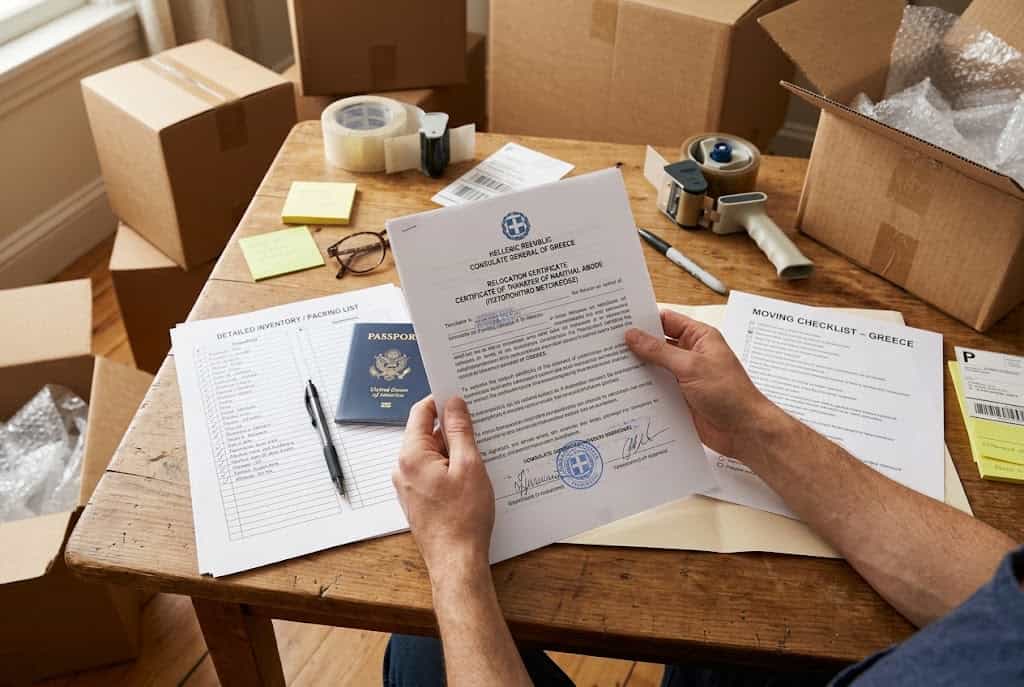
Japanese customs clearance for household goods requires a specific set of documents. Incomplete or inaccurate paperwork is the most common cause of shipment holds and additional storage charges at the destination port. Prepare the following before your shipment departs Los Angeles.
- Passport copy, including the page showing your Japan entry stamp or visa
- Detailed packing list or inventory with item descriptions, quantities, and declared values in Japanese yen or US dollars. General descriptions like “household goods” or “personal effects” are not sufficient. Japan Customs expects item-level detail.
- Bill of Lading issued by your ocean carrier
- Customs declaration form (completed by your Japan-side customs broker)
- Proof of residence in Japan, such as your Certificate of Alien Registration or rental agreement
- Proof of prior overseas residence, particularly if you are claiming the personal effects duty exemption as a returning resident or new arrival
Our professional export packing team creates an item-level inventory during the packing process in Los Angeles. This inventory is prepared in the format required for customs and doubles as your insurance documentation, which matters if any items are damaged or lost in transit.
Prohibited and Restricted Items
Japan maintains strict import controls on certain categories of goods. Items in the following categories are prohibited from entry and will be confiscated at customs, regardless of whether they are part of a personal effects shipment.
- Narcotics and controlled substances, including some medications that are legal in the US but prohibited in Japan. Stimulants such as Adderall and certain cold medications containing pseudoephedrine are banned in Japan. If you take prescription medication, verify its status with the Japanese Embassy or Ministry of Health before packing it.
- Firearms and ammunition
- Certain knives and bladed weapons exceeding length limits
- Counterfeit goods or items infringing on intellectual property rights
- Obscene or pornographic materials
Restricted items that require advance permission or inspection include certain plant materials, fresh food, seeds, and animal products. If you are shipping any items in these categories, obtain the necessary permits before your shipment departs Los Angeles. Attempting to clear restricted items without documentation causes delays that can result in significant port storage fees on the Japan side.
For a broader overview of customs documentation and international import requirements, see our international customs regulations guide.
Electronics and Appliances
Japan operates on 100 volts at 50Hz (eastern Japan) or 60Hz (western Japan). US appliances run on 120 volts at 60Hz. Most modern electronics such as laptops, phone chargers, and cameras are dual-voltage and will work with a plug adapter. Large appliances including microwaves, hair dryers, and kitchen equipment are generally not worth shipping. They will not function correctly on Japanese voltage without a step-down transformer, and Japanese-market replacements are readily available.
Televisions are another consideration. US NTSC-format televisions are not compatible with Japan’s ISDB-T broadcast standard. If you plan to watch Japanese television, you will need a Japanese-market set.
Shipping Options from Los Angeles to Japan
Most household goods shipments from LA to Japan move by ocean freight through the Port of Los Angeles or Port of Long Beach, with arrival at Tokyo (Tokyo Bay area), Yokohama, Osaka, or Nagoya depending on your destination address in Japan.
Full Container Load
For larger households, a dedicated 20-foot or 40-foot container gives you the most control over timing and handling. Your goods are loaded, sealed, and shipped as a single unit with no consolidation delays.
Less-Than-Container Load (LCL)
For smaller volumes, shared container space is available on the LA-to-Japan lane and is significantly more cost-effective when your shipment does not fill a full container. LCL adds some time at both ends for consolidation and deconsolidation, which is worth factoring into your customs timing calculation.
Get a Quote for Your LA to Japan Move
If you are planning a household goods shipment from Los Angeles to Japan, call 877-339-0267 or request an estimate online. We will walk you through container options, transit timing, and the documentation your shipment will need to clear Japanese customs without delays.