How to Prepare for Your Move from Spain to the USA: A Pre-Departure Checklist
Moving from Spain to the United States means closing out one life while a container crosses the Atlantic toward another. The order of the steps matters more than the speed. U.S. Customs wants proof that your belongings have been used abroad for at least a year, and your shipment should not land before you do.
SDC is a licensed overseas moving company serving all 50 states with almost 20 years of experience, and this checklist covers what to settle before you leave Spain. It is written for household goods moves from Barcelona, Madrid, Valencia, and everywhere between, by sea or by air.
Start 3 to 6 Months Out
A timeline this early gives you slack for the things you cannot control, such as visa appointments and sailing schedules.
- Pick your U.S. arrival date. Freight scheduling from Spanish ports like Barcelona or Valencia works backward from it.
- Book a consultation. A coordinator walks through shipping options, U.S. Customs, and insurance. Call 877-339-0267.
- Size your shipment. A full household usually justifies a full container; a smaller one may fit groupage, where you share container space.
- Reserve your pack dates 6 to 8 weeks ahead, and earlier for summer.
Gather and Organize Your Documents
- Passport and U.S. visa or residency approval. Check validity dates now, not the week before you fly.
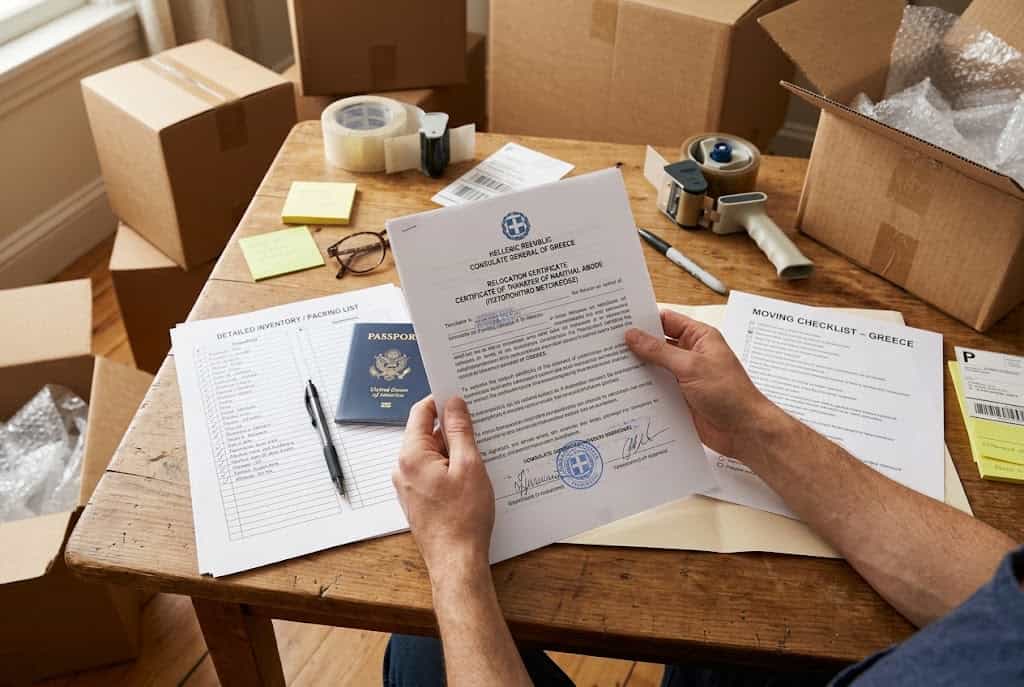
- Birth certificates, marriage records, and school records. Documents issued in Spain usually need an apostille to be accepted by U.S. agencies and schools, so ask each receiving office what it requires.
- Vaccination and medical records for every family member.
- Shipping paperwork. SDC prepares your inventory, the Bill of Lading or Air Waybill, and the U.S. Customs declaration for your belongings.
Scan everything and keep originals in one waterproof folder. Our customs regulations guide explains how the paperwork fits together for any destination.
Build a Detailed Inventory
The inventory drives packing, the Customs declaration, and insurance, so vague entries cost you later. Describe each item specifically (“oak dining table,” not “furniture”), note whether it is new or used, and record serial numbers for electronics. List it in English, and label boxes in English and Spanish so a Customs officer can follow along.
Be especially careful with anything bought recently. The U.S. duty-free rule covers belongings used abroad for at least a year, so new purchases may be dutiable and should be listed honestly.
Downsize Before You Pack
Sort everything into four piles: ship, store, donate, discard. Discard what is broken or prohibited, such as aerosols and perishable food.
Think hard about large appliances. Spain runs on 230 volts at 50 Hz and the U.S. on 120 volts at 60 Hz. A transformer fixes the voltage but not the frequency, and motors built for 50 Hz can run hot on 60. Refrigerators, washers, dryers, and ovens are often cheaper to sell in Spain and replace in the U.S. than to ship. Laptops and phone chargers are a different story, since most accept both voltages and need only a plug adapter.
Book Packing and Freight Early
- Professional packing. Export-grade materials protect antiques, electronics, and furniture, and the carton-by-carton record it produces is what Customs checks. See our packing service.
- Full container. Best for a full household, with exclusive use of the container.
- Groupage (shared container). More economical for a smaller load, but it runs longer because of consolidation at each end.
- Air freight. Suited to a small box of essentials. Ask your coordinator for current transit ranges.
Your coordinator recommends a mix based on volume and the date you need things on the other side.
If You Are Shipping a Car
SDC ships cars and motorcycles only when they are containerized with household goods, and does not handle vehicle-only shipments. Before you commit, know that a car built for the Spanish market generally has to meet U.S. EPA and DOT standards, and vehicles under 25 years old that do not are difficult and costly to bring into compliance. Confirm eligibility with your coordinator before the car is cleaned, photographed, or loaded.
Gather the title, registration, and purchase records, clean the car thoroughly (soil and plant debris can trigger agricultural inspection), and list its make, model, and VIN on the inventory.
Close Out Spain
- Utilities and subscriptions. Cancel or transfer electricity, water, internet, and phone, and end gym and streaming memberships.
- Banks. Tell your Spanish bank you are leaving, stop direct debits, and set up international transfers or a U.S. account.
- Taxes, pension, and social security. Settle these with a Spanish accountant before you go.
- Town hall. Notify your ayuntamiento so your residency record is updated.
- Mail. Arrange forwarding through Correos.
Prepare for U.S. Customs
U.S. rules allow used household effects to enter duty-free when they were actually used abroad for not less than one year, and when they are not intended for sale. You prove it with a Customs declaration (CBP Form 3299) and an accurate inventory. A job offer or a lease does not qualify your belongings. Use of the goods does.
Timing matters too. Customs generally will not release a shipment until the owner has arrived, and a container that lands early can sit and collect storage and detention charges. Schedule so the goods arrive after you, not before.
- Make sure the inventory matches what is actually in the container.
- Leave out food, plants, and hazardous materials.
- Label boxes clearly in English and Spanish.
Insure the Move
Goods packed by SDC can carry all-risk coverage, which is the broadest option, and it is the reason to let professionals pack anything valuable. Vehicles are covered differently, under a limited total-loss option. The moving insurance guide explains each choice.
Storage, Family, and Arrival
If your U.S. home is not ready, storage on either side bridges the gap, and short-term or long-term terms are both available. Book temporary housing for your first weeks, line up utilities and a U.S. SIM card, and visit your destination first if you can.
Families should also collect transcripts and vaccination records for school enrollment and medical records and prescriptions for continuity of care. SDC does not ship pets, but we can refer you to trusted partners. Call 877-339-0267.
Two practical adjustments are worth planning now. A Spanish driver’s license may need to be exchanged or replaced within a set period, depending on your state. And U.S. health insurance works very differently from Spain’s public system, so research coverage before you land.
Questions About Moving From Spain to the USA
When should I start?
Three to six months out for planning, and book packing and freight 6 to 8 weeks before your pack date.
What do I need for U.S. Customs?
Your passport, your visa or residency approval, an accurate inventory, and CBP Form 3299. SDC prepares the shipping documents with you.
Can my car come with me?
Only in the container with your household goods, and only if it meets U.S. standards or qualifies for an exemption. Ask before you spend money on preparation.
What can’t I ship?
Food, plants, hazardous materials, and weapons are the usual exclusions. The customs guide linked above has the fuller picture, so check it before you pack.
Full container or groupage?
A full household usually fits a full container. If you have edited hard, groupage can save money, at the cost of a longer schedule.
Ready to plan? Send your coordinator the city you are leaving in Spain, the U.S. city you are moving to, a rough room-by-room list, and your target arrival date. Call 877-339-0267 or request a quote.